



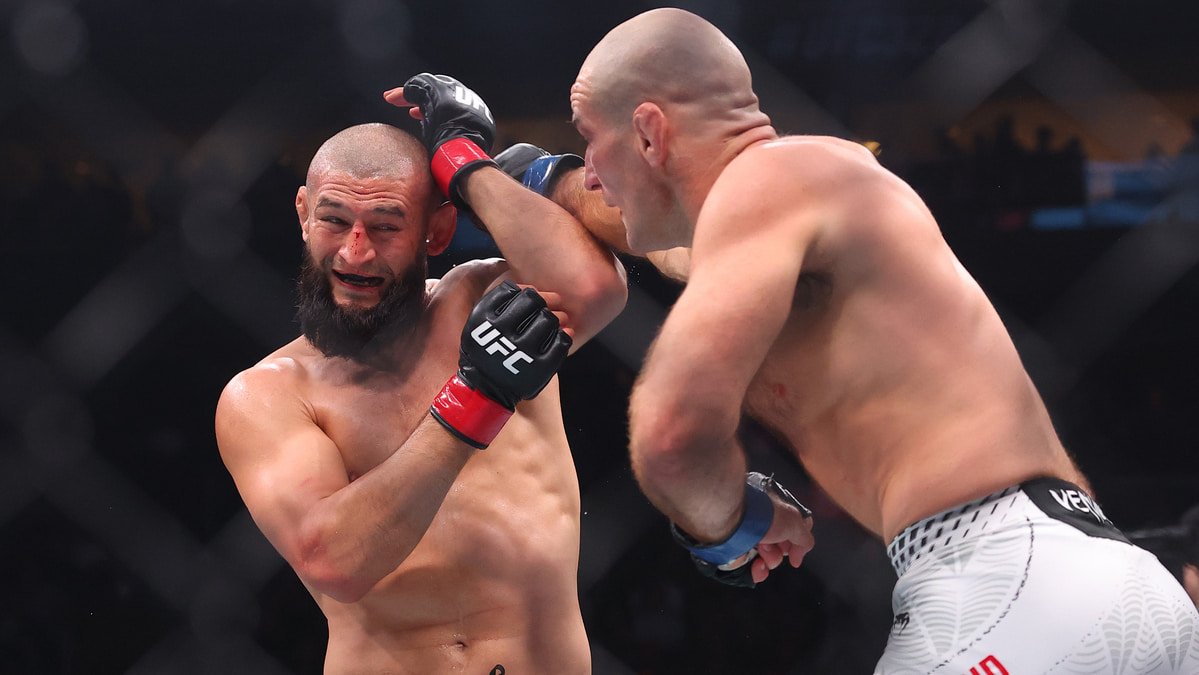
In many cities around the world, you don’t need to look at the clock to know something extraordinary is happening elsewhere. Late-night cafés still full, phones lifted above tables, faces locked onto a small screen showing a fight inside a cage. That was the atmosphere the night Khamzat Chimaev fell to Sean Strickland at UFC 328 inside the Prudential Center.
It was not just a defeat. Not just a belt changing hands in the middleweight division of the Ultimate Fighting Championship. It was the cracking of a narrative built over years — the idea of an unstoppable force, a modern sporting myth.
From the beginning, Chimaev was never presented as a normal fighter. He was engineered as a storm: fast finishes, physical dominance, psychological pressure. His nickname “Borz” became more than a name — it became a brand of invincibility. But in combat sports, invincibility is always temporary.
The opening round followed the expected script: early takedowns, dominant grappling, submission threats. But the real fight was not happening in space — it was happening in time, endurance, and adaptation.
Sean Strickland did not win through explosion or highlight moments. He won through resistance. Through patience. Through forcing the fight into a different kind of reality — one where chaos becomes fatigue, and fatigue becomes doubt.
By the second round, the shift was visible. Chimaev’s pace started to break. The fluidity slowed. The constant pressure began to leak energy instead of producing dominance. This is the moment where sporting myth collides with biological truth.
In combat sports, fatigue is not just physical. It is psychological. It exposes the gap between reputation and reality.
As the rounds progressed, Strickland imposed a slower, disciplined rhythm — almost anti-spectacle. He was not trying to impress the audience; he was dismantling the system that Chimaev depends on: speed, control, and fear.
And that is often how constructed invincibility falls — not through a single strike, but through erosion.
Beyond the cage, the meaning is larger. Modern combat sports are built on manufactured narratives: unstoppable champions, unstoppable styles, unstoppable eras. These narratives fuel promotion, media cycles, and global attention. But when they collapse, the impact goes beyond one athlete — it shakes an entire storytelling economy.
In the end, the question is not simply why Chimaev lost. The deeper question is why the world constantly needs invincible fighters, when the cage has never promised anything except one simple truth: human fragility, revealed under pressure.