


When Sport Becomes a Geopolitical Stage in Front of the White House… Where Is the Moroccan Fighter in the New Global Picture?
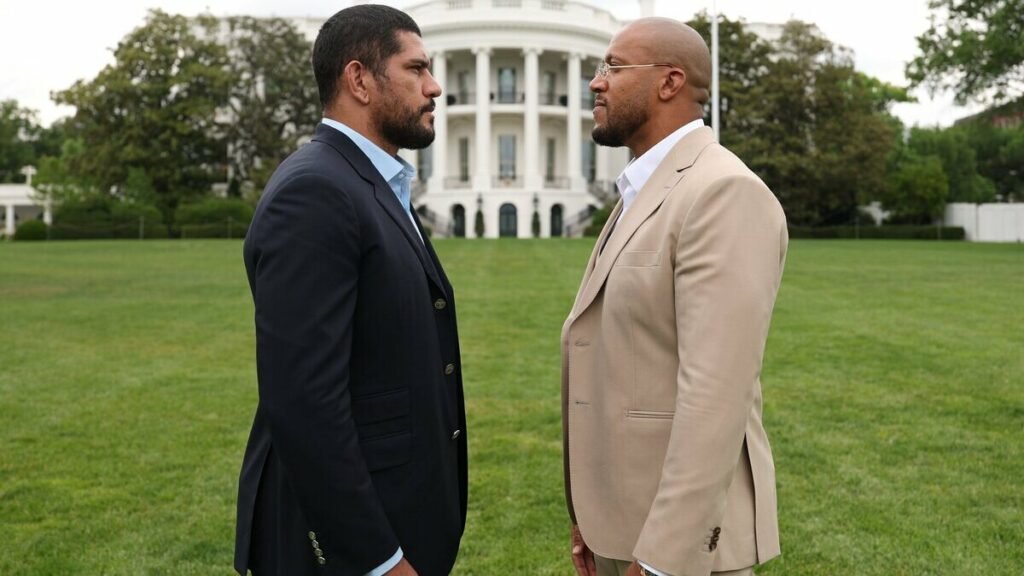
At a time when sport is no longer just competition inside a cage, but a political, media, and strategic spectacle watched by the entire world, Ciryl Gane and Alex Pereira stood face-to-face on the lawn of the White House. The moment went far beyond a simple UFC promotional staredown organized by the Ultimate Fighting Championship.
It symbolized something much larger: combat sports have become instruments of soft power, media influence, and geopolitical storytelling.
The event, backed by Donald Trump as part of the United States’ 250th anniversary celebrations, reveals how MMA has evolved from a marginal sport into a global platform capable of attracting tens of thousands of spectators and hundreds of millions of viewers worldwide. Fighters are no longer just athletes; they are media products, cultural ambassadors, and symbols of national identity.
But for Morocco, the real question is not simply who will win between Gane and Pereira. The deeper and more painful question is this: where is the Moroccan fighter in this new global architecture of combat sports?
In Morocco, champions are sometimes manufactured more on paper than inside the world’s elite organizations. Local heroes are heavily glorified within closed domestic circles, while the international reality exposes the enormous gap between a “local champion” and a “global fighter.” France now possesses a structured MMA development system. Brazil transformed martial arts into part of its national identity. The United States uses sport as a political and economic instrument. Meanwhile, Morocco remains trapped in federation conflicts, personal interests, favoritism, and outdated amateur mentalities.
The real problem is not a lack of Moroccan talent. The problem is the absence of a system capable of transforming talent into an international project. Morocco has thousands of young people from poor and working-class neighborhoods who see fighting as a path toward social and economic survival, just as many fighters once did in Brazil and Dagestan. Yet these athletes face institutions that do not truly believe in sports science, long-term planning, or professional athlete development.
In front of the White House, every detail was carefully designed: the suits, the cameras, the staging, the messaging, even the body language. This was not merely a sporting event. It was a demonstration of American symbolic power and the UFC’s global media dominance. That is where the true civilizational divide becomes visible: some nations manage sport with strategic vision, while others still operate through bureaucracy, improvisation, and narrow personal interests.
Perhaps the most dangerous issue is the collective illusion surrounding combat sports in Morocco. Media narratives are inflated, local achievements are excessively celebrated, yet real presence in the world’s biggest organizations remains limited and fragile. Moroccan fighters are often left alone: without elite performance centers, without professional management, without marketing structures, and without institutional protection.
As for the clash between Ciryl Gane and Alex Pereira, it carries meaning far beyond an interim heavyweight title. Gane represents European tactical discipline, mobility, and technical precision. Pereira embodies destructive Brazilian striking power and years of elite kickboxing experience.
If Gane succeeds in avoiding heavy exchanges during the early rounds, he could impose his rhythm and gradually wear Pereira down. But if Pereira manages to force direct exchanges, one punch could end the fight instantly. In many ways, this matchup feels like a collision between tactical intelligence and raw destructive force.
Yet beyond predictions and analysis, the most powerful image remains the one captured in front of the White House: the modern world is building its champions through long-term strategic projects, while parts of the Arab and African worlds are still producing champions mainly through photographs, slogans, and media illusions.