


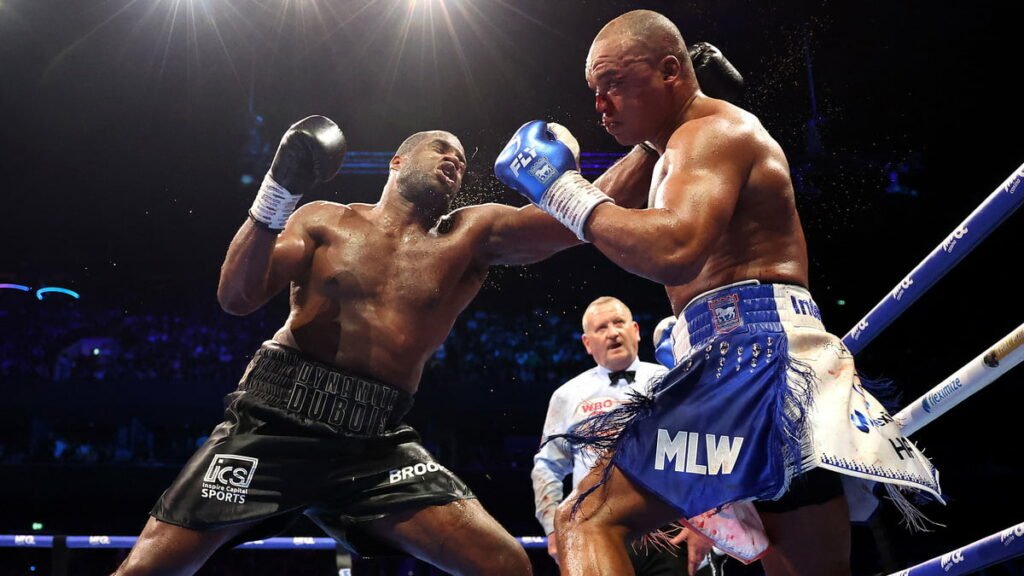
In many cities around the world, people no longer need a clock to know that the night has gone too far. All it takes is stepping out of a bar, a crowded café, or a tiny apartment crushed by the weight of everyday life to hear someone whisper: “Did you watch last night’s fight?” Combat sports are no longer just entertainment. They have become a psychological escape valve for a generation living on the edge of economic collapse and social anxiety, searching inside the ring for a form of justice they cannot find outside it. That is why, when Daniel Dubois hit the canvas only thirteen seconds into his fight against Fabio Wardley in Manchester, many believed the story was already over… But what followed felt more like a rewriting of the meaning of survival itself inside a sport that forgives nothing.
In those opening moments, the scene looked almost like a sporting disaster. The British crowd that had gathered for a heavyweight WBO war watched the defending champion land violently and send his opponent crashing to the floor immediately. Everything suggested that “Dynamite” Dubois was reliving the nightmare of his knockout loss to Oleksandr Usyk last year, when his biggest dream collapsed before the world.
But modern boxing is no longer decided only by physical power; it is decided by the ability to manage fear, absorb psychological collapse, and return from inside the storm itself.
Dubois already knocked to the ground in round 1 all in 13 secs pic.twitter.com/btuXSdrvNM
— Natty Jay (@JacobEniv) May 9, 2026
The first round was not simply a knockdown. It was a human test for a man emerging from a crushing defeat, from media doubt, and from the brutal question that follows every beaten fighter: “Is he finished?”
In combat sports, defeat does not only drop the body — it damages a man’s image before the world. That is why the fight in Manchester became far bigger than a world title. It became a battle for existence inside an industry that turns champions into commercial products consumed at terrifying speed.
— Arşiv (@ufc_turkiye) May 9, 2026
As the rounds passed, the ring transformed into a true war of attrition. The two men traded blows with a violence that reflected modern British boxing itself: direct, relentless, and driven more by willpower than calculation. Fabio Wardley was trying to protect the aura of the unbeaten champion, while Daniel Dubois fought like a man chasing the ghost of his own future.
Then came the turning point in round eleven.
Wardley began retreating toward the ropes, visibly exhausted, while Dubois sensed the moment every heavyweight waits for — the instant to launch the final assault. A brutal series of punches forced the referee to stop the fight. TKO victory. Dubois had ripped away the WBO title in front of a roaring Manchester crowd.
Yet behind this victory lies a story far larger than a championship belt.
British boxing today is not merely a sport; it is a massive economic and media industry governed by market logic. Every victory redraws the map of money, broadcasting rights, sponsorships, and future superfights. Dubois’ triumph means more than a return to the top — it signals the rebirth of a “champion project” capable of generating millions in views and revenue after his image had been shaken by defeat against Usyk.
The fight also exposed another truth about modern combat sports: the fragility of invincibility itself.
For years, the myth of the unbeatable fighter has been carefully manufactured, yet reality continues to prove that a single punch can alter history. One moment of hesitation can destroy an empire. That is precisely why audiences remain obsessed with combat sports: because they resemble life itself — unfair, unpredictable, and incapable of offering permanent guarantees.
Most importantly, the fight reopened the question of the human price behind these sports.
Fans see glory and spectacle, but they rarely see what remains inside fighters after these wars: neurological damage, invisible injuries, psychological pressure, and the fear of financial collapse after retirement. Every time the world celebrates a fighter who rises from defeat, another question remains hidden in the shadows: how many times can a human being stand back up before collapsing internally?
The victory of Daniel Dubois over Fabio Wardley was not simply a wild night in Manchester.
It was a brutal reminder that combat sports do not only create champions — they expose the nature of societies fascinated by watching a man fight against his own downfall… even when his pain becomes a global spectacle sold to millions.