



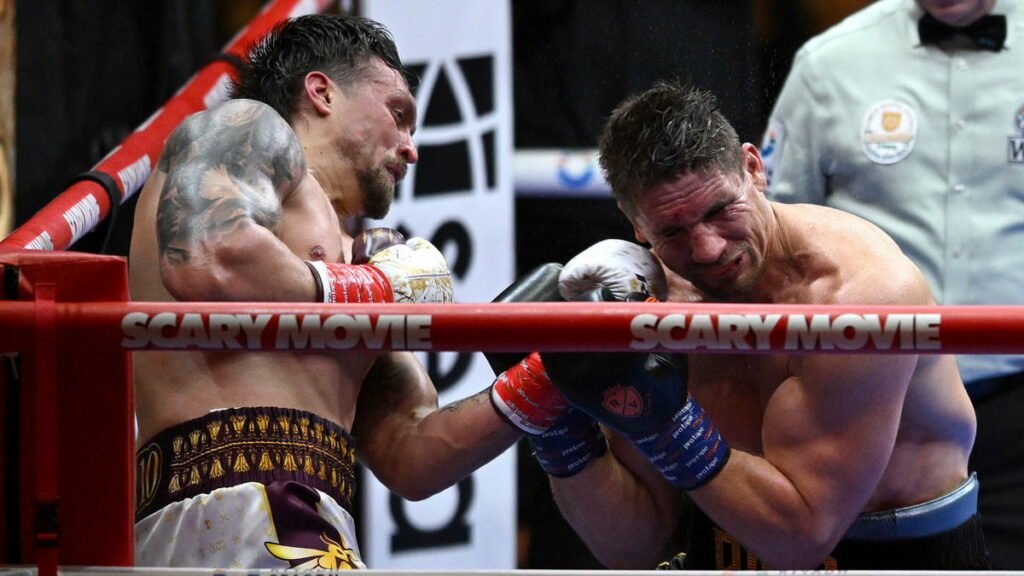
In a high-intensity scene staged in Cairo, Egypt, Ukraine’s Oleksandr Usyk faced Dutch powerhouse Rico Verhoeven in a fight that went far beyond a standard sporting matchup. From the moment it was announced, the bout was framed as a rare collision between two combat worlds: elite modern boxing on one side, and top-level kickboxing on the other.
From the opening rounds, the fight evolved into a complex tactical reading. Verhoeven, carrying his kickboxing pedigree, immediately imposed a heavy physical pace built on constant pressure and powerful combinations. At several moments, he disrupted Usyk’s defensive structure, forcing the Ukrainian to adjust his rhythm and rely on counterpunching to regain control.
Usyk, in turn, took time to settle into his usual system: distance management, lateral movement, and surgical precision. But as the rounds progressed, the fight entered a blurred zone where neither man could clearly assert dominance.
The turning point came in the closing stages, when Usyk suddenly increased the tempo in the 11th round. A sharp series of combinations and sustained pressure led the referee to step in and stop the fight, awarding the Ukrainian a TKO victory.
This angle of Oleksandr Usyk stopping Rico Verhoeven 😬
Ref was ready to go home 😅 pic.twitter.com/m9VX77YsKp
— Happy Punch (@HappyPunch) May 23, 2026
The decision immediately sparked controversy. A portion of the audience viewed the stoppage as premature or questionable, while others argued that the referee’s intervention was justified to protect the Dutch fighter’s safety.
Beyond the result itself, the fight leaves an open interpretation: a contest where the line between technical dominance and referee judgment becomes unclear, raising a central question — was Verhoeven truly in decisive danger, or should the bout have been allowed to continue?
In any case, Cairo hosted more than just a sporting outcome. It delivered a debate that will likely persist, questioning the hierarchy between disciplines and how critical moments in elite combat sports are interpreted.