


In combat sports, not every fight that is possible is worth making. Some bouts are driven by financial rewards, others by compelling narratives, while the rarest ones are carefully chosen to define a champion’s legacy before the curtain falls on an illustrious career. That is precisely the lens through which Rico Verhoeven’s latest decision should be viewed. His camp has firmly ruled out a boxing match against fellow Dutchman Alistair Overeem, despite the fact that Overeem has openly made it the centerpiece of his planned comeback.
At first glance, the statement from Verhoeven’s manager, Karim Erja, seemed straightforward. Yet beneath its simplicity lay a much deeper message. This was not a refusal born out of fear, nor was it an attempt to avoid a difficult opponent. It reflected a fundamental shift in priorities. Rico Verhoeven is no longer selecting opponents based on the challenge they present inside the ring, but on the chapter they can add to the story of his career.
Having dominated kickboxing for well over a decade, the Dutch superstar has entered the final stretch of his competitive journey. At this stage, accumulating victories is no longer enough. Every remaining appearance must strengthen his global legacy, elevate his profile beyond kickboxing, and cement his place among the most influential combat sports figures of his generation.
Viewed from this perspective, Alistair Overeem has become a victim of changing circumstances rather than diminishing ability. His résumé remains extraordinary, spanning elite kickboxing and mixed martial arts. However, at 46 years old, following retirement and now pursuing a comeback, he no longer represents the kind of opponent capable of redefining Verhoeven’s career trajectory. The issue, therefore, is not Overeem’s historical significance, but the future value of the fight itself.
Ironically, there was a time when this matchup appeared almost inevitable. In October 2022, the two men famously confronted each other inside the ring following Overeem’s bout with Badr Hari. That tense faceoff ignited widespread speculation and convinced many fans that a blockbuster showdown was only a matter of time. Instead, fate intervened. Verhoeven suffered a serious knee injury shortly afterward, while Overeem received a suspension for violating anti-doping regulations, effectively burying the fight before negotiations could truly begin.
Today, the landscape has changed dramatically.
Rico Verhoeven is no longer simply the dominant force in kickboxing. He has transformed himself into an international combat sports brand seeking challenges beyond the discipline that made him famous. His move into professional boxing was never intended as a one-off experiment; it was a calculated strategy to broaden his legacy and compete on the biggest possible stage.
His showdown with Oleksandr Usyk perfectly illustrated that ambition. Although he ultimately fell short, Verhoeven exceeded expectations by pushing one of boxing’s greatest champions far harder than many believed possible. That performance significantly enhanced his credibility and proved that he possesses legitimate value outside the kickboxing world.
Which naturally raises the real question:
If Overeem is no longer part of the equation, who is?
This is where Verhoeven’s camp becomes particularly intriguing. Karim Erja deliberately avoided committing to any specific direction, emphasizing that every option remains under consideration, whether in boxing or mixed martial arts. Such remarks suggest that the team’s decision-making process extends far beyond sporting competition. Prestige, commercial value, media attention, and historical significance are all being weighed together.
That brings one name back into the spotlight once again:
Francis Ngannou.
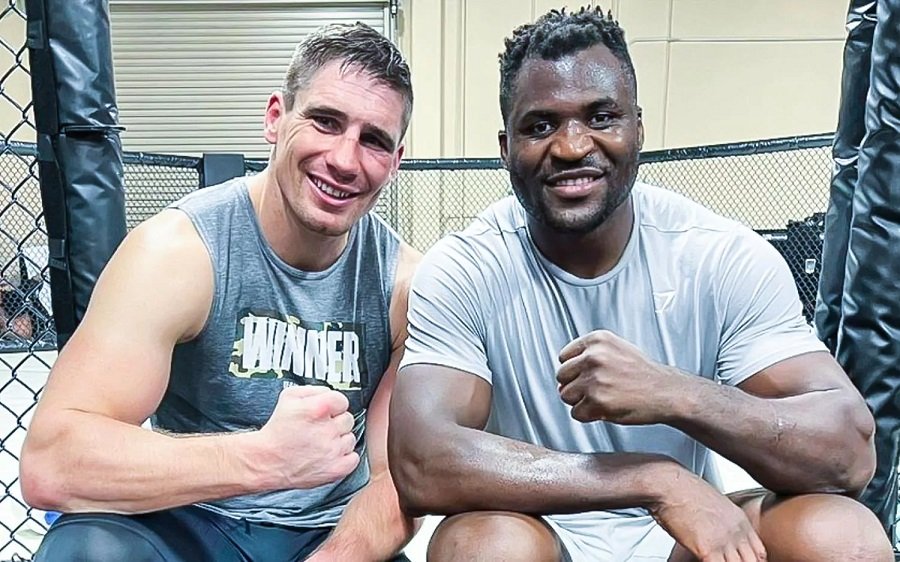
For months, speculation has surrounded the possibility of a blockbuster showdown between the Dutch kickboxing king and the Cameroonian powerhouse, whether under boxing rules or within a specially designed cross-discipline format. Following Ngannou’s remarkable performances against Tyson Fury and Anthony Joshua, he has become one of the most marketable figures in global combat sports. Meanwhile, Verhoeven is actively pursuing opponents capable of transforming a sporting contest into a worldwide spectacle.
But should fans genuinely expect this fight to happen?
At this stage, the answer remains cautious:
Not yet.
Despite months of media hype and widespread promotional speculation, no official agreement has been reached, and no contract has been announced for a Verhoeven–Ngannou showdown. The matchup currently exists more as an exciting concept than an imminent reality. Ngannou’s commitments across boxing and mixed martial arts, combined with Verhoeven’s own strategic ambitions, make such negotiations highly attractive but equally complex.
The same reasoning applies to previous reports linking Verhoeven with the UFC. Interest from the world’s premier MMA organization undoubtedly reflects his growing market value, but it should not be interpreted as confirmation that a move is imminent. Rather, it demonstrates how successfully Verhoeven has positioned himself as a crossover attraction capable of generating interest across multiple combat sports.
This evolution perhaps says more about Rico Verhoeven than any single victory ever could.
A few years ago, he fought to prove he was the greatest kickboxer in the world.
Today, he fights to determine how history will remember him.
That is why the defining question is no longer who has the best chance of defeating Rico Verhoeven.
The real question is:
Who can add the most meaningful chapter to his legacy?
Alistair Overeem remains one of combat sports’ most respected names, but he no longer represents the symbolic leap Verhoeven seeks. A showdown with Francis Ngannou—or even an unexpected transition to the UFC—would carry significantly greater commercial impact, broader international attention, and stronger historical significance, even if those opportunities are considerably more difficult to bring to life.
Ultimately, the message coming from Verhoeven’s camp is unmistakable. The closing chapter of his career will not be shaped by emotion, unfinished rivalries, or nostalgic storylines. It will be carefully constructed around legacy.
That leaves combat sports fans with one compelling question:
Will the dream fight between Rico Verhoeven and Francis Ngannou finally materialize, or will it remain one of those super-fights that dominate headlines yet never make it into the ring?
For now, only possibilities exist.
The final decisions are still being made behind closed doors—where the biggest fights in combat sports are planned long before they are officially announced to the world.