


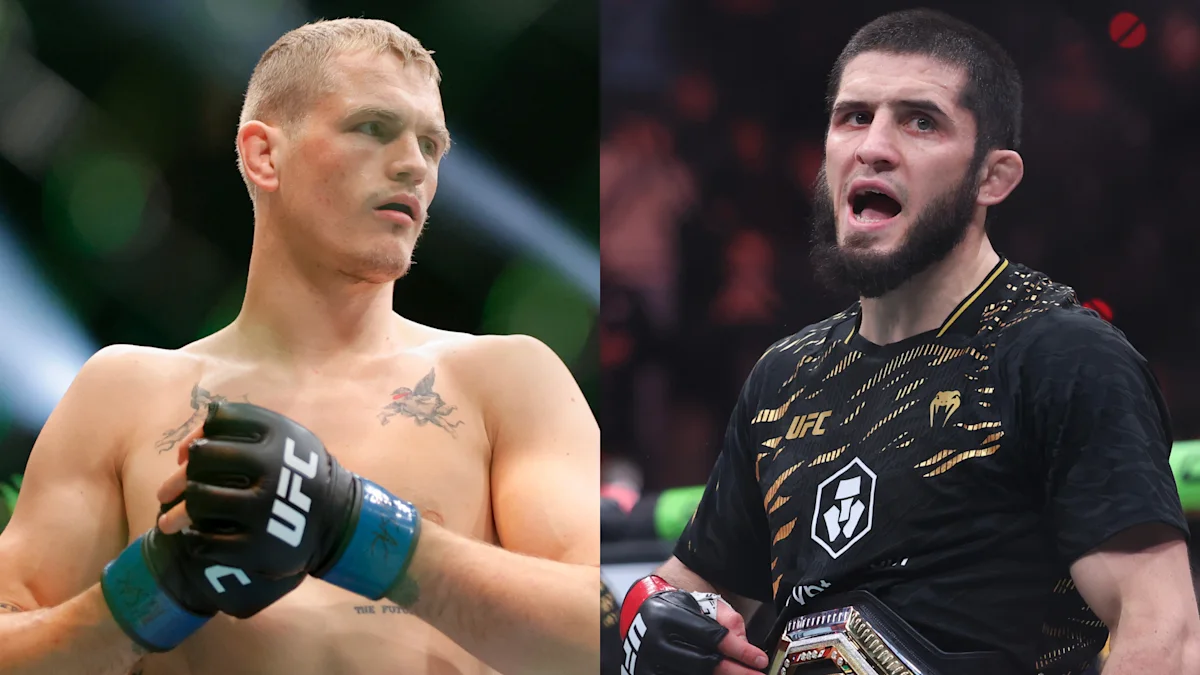
Just days before a fight that could reshape the balance of power inside the UFC, Ian Machado Garry has chosen to revisit a subject that, on the surface, appears unrelated to his upcoming clash with Islam Makhachev. Yet beneath his comments on Khabib Nurmagomedov’s retirement lies a far broader conversation—one about the meaning of legacy, the true definition of success, and the delicate line separating sporting greatness from personal fulfillment.
Standing on the doorstep of the biggest fight of his professional career, the Irish contender could have used the Dagestani legacy as ammunition for psychological warfare. He could have echoed the familiar rhetoric adopted by many opponents of that camp, built around provocation and symbolic confrontation. Instead, Garry has taken a remarkably different path, publicly defending Khabib’s decision to retire at the height of his career and offering a perspective rooted in humanity rather than pre-fight theatrics.
When Khabib Nurmagomedov retired in 2020 with a flawless professional record of 29 victories and no defeats, he walked away carrying far more than an undefeated résumé. Only months earlier, he had lost his father, Abdulmanap Nurmagomedov—the mentor, coach, strategist and architect of everything he had become inside the Octagon. Despite unlimited financial opportunities, blockbuster fights and the possibility of extending one of the greatest reigns in MMA history, Khabib chose to leave while standing at the summit, honoring the promise he had made to his family and demonstrating that some decisions transcend championships and financial rewards.
It is precisely this dimension that Ian Machado Garry chooses to emphasize. In his view, Khabib’s decision neither requires justification nor deserves criticism. Having lost the man who was simultaneously his father, closest friend and lifelong mentor, it was only natural for him to redefine his priorities. For Garry, a champion’s worth cannot be measured solely by the number of fights he wins or the wealth he accumulates, but also by his ability to make life-changing decisions that remain faithful to his deepest convictions—even when those choices run against public expectations and the commercial interests of the sport.
This perspective reflects a subtle but significant shift in the discourse surrounding the UFC. In a sport where narratives are often driven by ego, endless ambition and the relentless pursuit of records, Garry presents an almost counter-cultural argument: success is not always defined by staying in the fight forever. Sometimes, leaving at the peak requires greater courage than continuing to compete.
The true significance of Garry’s comments also lies in the figure they implicitly challenge. His position stands in sharp contrast to that of fellow Irishman Conor McGregor, who has repeatedly argued that Khabib retired far too early. McGregor has long maintained that the Dagestani could have continued dominating the lightweight division and expanded an already legendary legacy. Two competing philosophies emerge from this divide. One believes greatness is built by extending dominance for as long as possible; the other argues that greatness also lies in knowing precisely when it is time to walk away.
Beyond a simple disagreement over Khabib’s career, this contrast reveals two fundamentally different interpretations of elite competition. The first views legacy as the product of title defenses, records and longevity. The second suggests that a champion’s greatest achievement may be remaining loyal to his principles—even when doing so means voluntarily turning away from fame, fortune and sporting immortality.
Although Garry’s remarks appear to be directed toward Khabib, their message inevitably reaches Islam Makhachev, the athletic heir to the Dagestani fighting philosophy. By publicly respecting Khabib’s decision, Garry subtly communicates that his battle is not with individuals or historical narratives, but with the man who currently holds the championship belt. In doing so, he reframes the contest as a purely sporting challenge rather than a deeply personal rivalry, distancing himself from the emotional hostility that often dominates the build-up to major UFC events.
At the same time, this respectful tone may itself represent a calculated strategic move. By refusing to fuel personal animosity and instead acknowledging the values of the opposing camp, Garry shifts the focus away from verbal warfare and toward technical competition. It is a way of ensuring that, once the Octagon door closes, the outcome will depend solely on skill, tactical intelligence and performance—not on emotions generated during fight week.
Ultimately, Ian Machado Garry’s comments go far beyond defending Khabib Nurmagomedov’s retirement. They also serve as a portrait of the man Garry wants the world to see. A fighter who believes that legacy is measured not only by victories accumulated, but by the wisdom shown when making life’s defining decisions. Between Conor McGregor’s philosophy of relentlessly pursuing glory and Garry’s belief that the human being must come before the champion, another contest unfolds alongside the one inside the Octagon—a contest between two visions of success, two understandings of ambition and two competing definitions of what it truly costs to become a legend.