


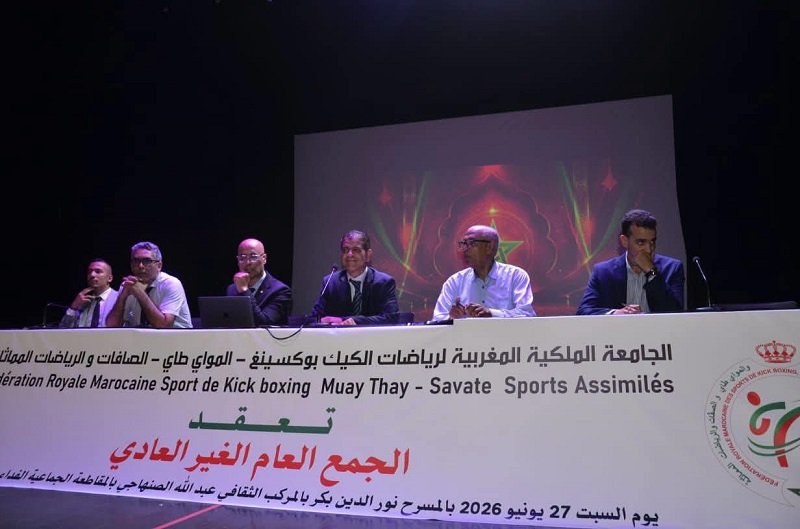
Not every name that appears in an official statement carries the same significance. Some are mentioned merely as participants in an event, while others are included in a way that invites broader questions about responsibility—even when no formal legal accusation is made. This is precisely the context surrounding the statement issued by the Royal Moroccan Federation of Kickboxing, Muay Thai, Savate and Similar Disciplines following its Extraordinary General Assembly held on 27 June 2026: why did the federation specifically mention Idriss El Hilali, President of the Royal Moroccan Taekwondo Federation, while simultaneously stressing that determining responsibility remains exclusively within the jurisdiction of the competent judicial and administrative authorities?
The issue extends beyond Idriss El Hilali as an individual. It concerns the legal and institutional implications of naming the president of another national sports federation in a communiqué describing an internal governance crisis. The statement does more than recount what happened inside the meeting hall; it broadens the narrative by introducing actors from outside the federation itself. As a result, the reference carries a meaning that goes well beyond a simple chronological account of events.
From Describing Events to Constructing an Official Narrative
Viewed through a legal lens, the federation’s statement is carefully drafted.
It does not claim that the President of the Taekwondo Federation committed a criminal offence, nor does it attribute any legally established liability to him. Instead, it states that he “intervened alongside the individuals who interrupted the proceedings of the General Assembly,” before immediately adding a crucial clarification: that the determination of responsibility belongs solely to the competent judicial and administrative authorities based on the evidence and documentation that will be submitted to them.
This wording is far from incidental.
It reflects what may be described as institutional restraint—a clear distinction between the federation’s own account of events and the legal determination of responsibility, which remains exclusively the role of the courts and competent authorities.
In other words, the federation appears to have intended to place on official record that, according to its own version of events, Idriss El Hilali’s presence and intervention were not viewed as ordinary occurrences, while deliberately avoiding any formal judicial accusation.
Why Mention Idriss El Hilali Specifically?
Institutionally, Idriss El Hilali occupies a position that extends well beyond leading a single sports federation. Over many years, he has become one of the most recognizable figures within Moroccan sport, maintaining a visible presence across national, continental and international sporting bodies.
For that reason, the appearance of his name in an official communiqué cannot reasonably be interpreted as an insignificant detail. Rather, it functions as a political and institutional signal suggesting that, in the federation’s view, what occurred was not merely an internal dispute among its own officials but an episode involving influential figures from outside its organizational structure.
The wording itself is revealing.
The statement does not simply refer to “individuals”; it explicitly identifies a prominent personality within Moroccan sport. Doing so strengthens the federation’s official narrative while simultaneously preserving Mr. El Hilali’s full right to respond publicly, clarify his position, or pursue legal remedies should he consider that the communiqué has affected his reputation or legal interests.
Does the Statement Indirectly Attribute Responsibility to Him?
From an analytical perspective, the answer is nuanced.
Politically and institutionally, it appears to suggest such responsibility. Legally, however, it does not establish it.
That distinction is fundamental.
The communiqué links together several developments:
- the interruption of the General Assembly;
- the occupation of the platform;
- the departure of representatives from the Ministry and the Moroccan National Olympic Committee;
- and then refers to the intervention of the President of the Taekwondo Federation during those events.
For readers, this sequence naturally creates the impression of a relationship between those developments.
Yet almost immediately afterward, the federation introduces an essential legal safeguard by reaffirming that only the competent judicial and administrative authorities are empowered to determine responsibility.
This drafting technique is common in sensitive institutional communications: presenting an organization’s version of events without transforming that version into a legal judgment.
Why Avoid Using the Word “Accusation”?
Because legally, the word carries significant consequences.
The federation appears fully aware that Moroccan law—as well as universally recognized principles protecting reputation and the presumption of innocence—requires considerable caution before attributing unlawful conduct to any individual in the absence of judicial findings.
That explains the repeated use of expressions such as:
- “raises questions”;
- “according to observations”;
- “based on testimonies”;
- “the evidence will be submitted to the competent authorities.”
These formulations allow the institution to express its concerns while remaining, at least formally, within the boundaries of reporting facts rather than issuing legal conclusions.
Was Mentioning His Name Also a Communication Strategy?
From the perspective of institutional crisis management, this appears entirely plausible.
The federation seems intent on demonstrating that the failure of the Extraordinary General Assembly should not be understood solely as an internal dispute among former board members who had resigned, but rather as a broader crisis involving influential personalities from the Moroccan sporting community.
Organizations facing institutional crises frequently seek to broaden the explanatory framework surrounding an event in order to justify to stakeholders and public opinion why an important meeting failed to reach its intended conclusion.
Within that framework, naming a well-known sports leader becomes part of constructing the federation’s official narrative rather than, in itself, constituting a legal accusation.
What Does the Law Actually Say?
Legally speaking, simply mentioning someone’s name in an official statement does not establish liability.
Responsibility can only be determined through legally admissible evidence, including:
- judicial police reports;
- video or audio recordings, where available;
- witness testimony;
- reports prepared by court-appointed judicial officers;
- and the conclusions ultimately reached by prosecutors or competent administrative authorities.
This is precisely why the federation explicitly leaves the matter open for investigation, consistent with the fundamental principle of the presumption of innocence.
Moroccan Sport Faces a Broader Governance Test
Beyond the individuals involved, this controversy exposes a much deeper issue concerning the governance of Moroccan sport.
When general assemblies become arenas of confrontation and official statements evolve into competing instruments of public narrative, the crisis extends beyond personalities and begins to challenge the credibility of sports governance itself.
Sports federations are not merely organizations responsible for staging competitions. They are institutions entrusted with managing an important component of public sporting life. Consequently, conflicts within these bodies inevitably affect the image of national sport, as well as the confidence of clubs, athletes, public authorities and institutional partners.
Conclusion: A Name Is Not a Verdict—But It Can Be a Message
Ultimately, the inclusion of Idriss El Hilali’s name in the communiqué issued by the Royal Moroccan Federation of Kickboxing represents a development of considerable institutional and media significance. However, it does not constitute a judicial finding, nor does it amount to proof of legal responsibility.
The statement reflects the federation’s own interpretation of events while raising questions about the role of certain participants. At the same time, it expressly leaves the determination of legal responsibility to the competent judicial and administrative authorities.
This leads to an even more fundamental question—one that reaches far beyond a single General Assembly:
Have official statements in sports governance disputes remained instruments for informing the public, or have they increasingly become strategic tools for shaping competing narratives capable of influencing public perception long before courts or competent institutions establish the facts?
That question extends well beyond this particular controversy. It goes to the heart of the future of sports governance in Morocco, where institutional credibility ultimately depends upon maintaining a clear distinction between administrative conflict, responsible public communication, and unwavering respect for the legal rights and procedural guarantees owed to every party involved.