


The main event of UFC 329 was expected to mark one of the most anticipated comebacks in modern mixed martial arts. After five years away from competition, Conor McGregor finally returned to the Octagon for a long-awaited rematch against Max Holloway, thirteen years after their first encounter. Instead, what millions of fans expected to be a defining chapter in McGregor’s legacy ended in less than a minute, as a dream return turned into one of the cruelest endings imaginable.
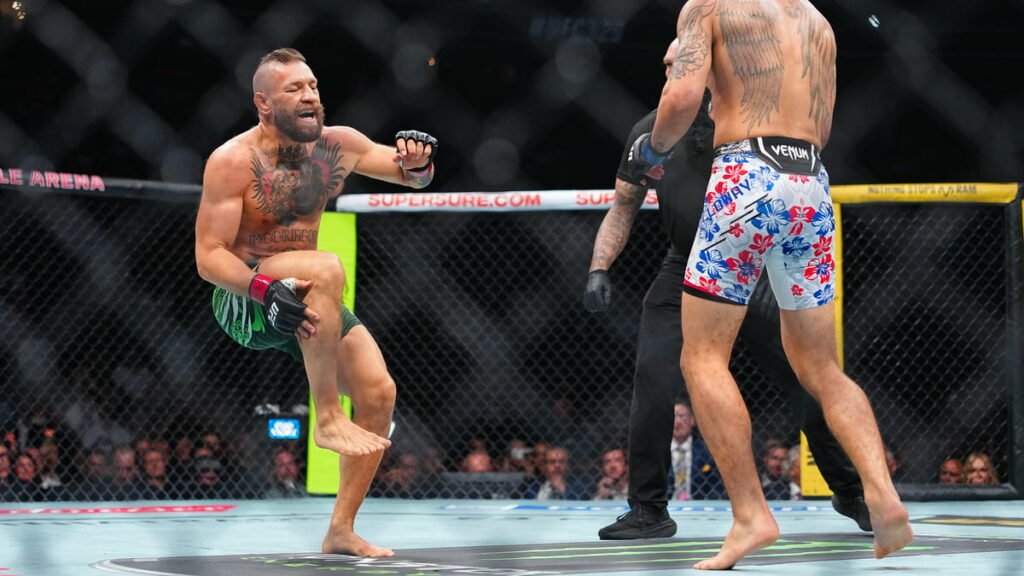
McGregor opened the fight with the aggressive intent that has defined his career, throwing kicks and moving forward in an effort to unsettle Holloway from the opening seconds. Yet that explosive start never had the opportunity to evolve into a genuine tactical battle. During one of his offensive movements, the Irish superstar suffered a serious knee injury, collapsing to the canvas as the sold-out arena fell into stunned silence.
Sensing the opportunity, Max Holloway immediately followed with ground strikes, attempting to capitalize on the unexpected turn of events. McGregor managed to stand, but the damage was already evident. Unable to put weight on his injured leg or continue competing safely, he left the referee with little choice but to wave off the contest, awarding Holloway a first-round TKO victory.
Officially, the result adds another important win to Holloway’s remarkable résumé. Competitively, however, the outcome feels incomplete. The fight ended before either athlete had the chance to demonstrate the technical and strategic qualities that made this rematch one of the most highly anticipated events of the year, leaving fans without the answers they had waited years to see.
For McGregor, the defeat carries implications far beyond a mark in the loss column. This comeback represented an opportunity to prove that five years away from the Octagon had not diminished his ability to compete with the sport’s elite. It was meant to reaffirm that “The Notorious” remained a legitimate force in the UFC’s biggest fights. Instead, the abrupt ending revives a question that has increasingly surrounded the latter stages of his career: has his greatest opponent become his own body rather than the men standing across the cage?
On the other side, Holloway walks away with an official victory but not necessarily the sporting validation he had hoped to earn. The former champion appeared eager to settle the rivalry through a complete contest rather than an injury-induced stoppage, which explains why he wasted no time calling for a trilogy fight immediately after the bout.
Viewed through a broader lens, the UFC 329 main event serves as another reminder of one of combat sports’ harshest realities. The line separating spectacle from competition can disappear in a single moment. A fight built on years of history, anticipation and global attention ended before it could reveal which fighter truly held the upper hand, leaving the UFC facing difficult questions about McGregor’s future and whether this rivalry deserves one final chapter under circumstances that allow skill—not misfortune—to determine the outcome.
Between Holloway’s official victory and McGregor’s comeback cut painfully short, UFC 329 leaves behind more uncertainty than resolution. It is yet another reminder that in mixed martial arts, greatness is measured not only by talent, legacy or star power, but also by a fighter’s ability to withstand the unforgiving demands of elite competition when the moment of truth finally arrives.