


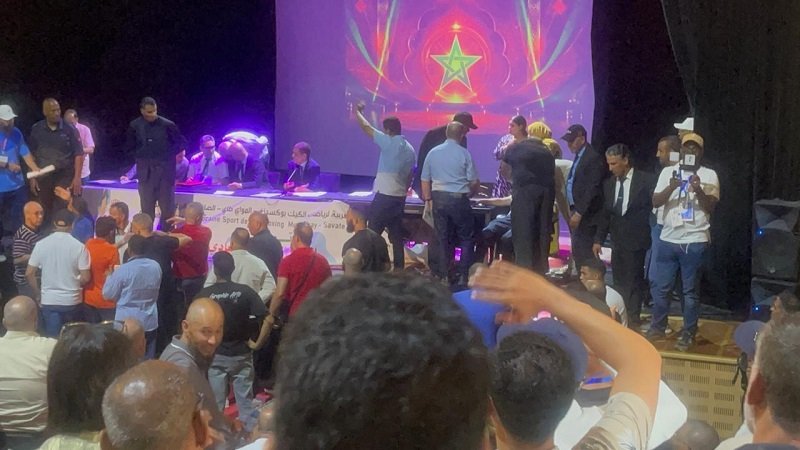
Some meetings begin with attendance sheets, neatly arranged documents, and a carefully prepared agenda. Others end up revealing a much deeper institutional crisis than anything written on the agenda itself. The Extraordinary General Assembly of the Royal Moroccan Kickboxing Federation, held in Casablanca, belongs to the latter category. What was expected to be a statutory gathering to discuss the future of one of Morocco’s fastest-growing combat sports instead descended into a tense confrontation, culminating in the withdrawal of representatives from the Ministry of National Education, Preschool and Sports and the Moroccan National Olympic Committee, followed by the suspension of the Assembly’s proceedings. More than an organizational setback, the incident has become another window into broader questions surrounding governance in Moroccan sport, institutional oversight, and the ability of sports bodies to manage internal conflicts within a democratic framework.
According to the information currently available, tensions escalated after participants inside the meeting hall began chanting slogans demanding the resignation of Federation President Kandili. What initially appeared to be expressions of dissatisfaction quickly evolved into heated verbal exchanges between the president and several attendees, creating an atmosphere of significant unrest. Faced with these conditions, representatives of both the supervising ministry and the Moroccan National Olympic Committee decided to leave the meeting, effectively bringing the Extraordinary General Assembly to a premature end before its agenda could be completed.
Yet interpreting this episode merely as a confrontation between opposing camps would overlook its broader institutional significance. The simultaneous withdrawal of representatives from two of Morocco’s principal public sports institutions carries a symbolic weight that extends well beyond the walls of the meeting room. It suggests that, at least in the judgment of those institutions, the conditions required for the orderly continuation of the Assembly were no longer present.
The incident also unfolds against a wider backdrop in which questions surrounding governance, transparency, and internal democracy have become increasingly prominent within several Moroccan sports federations. Since the implementation of Law No. 30-09 governing physical education and sports, principles such as good governance, accountability, institutional transparency, and respect for statutory procedures have become central benchmarks for evaluating the performance of sports organizations. Federations today are assessed not solely by medals and championships but also by the quality of their institutional management.
A sports federation is far more than an association responsible for organizing competitions. It is an institution entrusted with a public mission. It manages public funding, oversees athlete development, trains coaches and referees, organizes national competitions, and represents Morocco before international governing bodies. Consequently, institutional instability within such an organization extends beyond internal administrative affairs to affect public trust, the stewardship of public resources, and the credibility of Moroccan sport as a whole.
The presence of representatives from the Ministry and the National Olympic Committee during General Assemblies is not intended to influence elections or internal political debates. Rather, their role is to observe compliance with legal and regulatory frameworks governing sports federations. Their decision to withdraw therefore carries considerable institutional symbolism. It implicitly indicates that the environment had become incompatible with the orderly conduct of the Assembly. Nevertheless, the precise reasons behind that decision remain unknown pending official clarification.
At the time of writing, neither the Ministry, the Moroccan National Olympic Committee, nor the Royal Moroccan Kickboxing Federation has issued an official statement explaining the circumstances surrounding the suspension of the Assembly. This institutional silence has inevitably created space for speculation and conflicting narratives. In an era where transparency forms an essential pillar of modern governance, timely official communication is no longer optional; it is fundamental to preserving confidence among clubs, regional leagues, athletes, and the wider sporting community.
From a legal perspective, the interruption of an Extraordinary General Assembly before the completion of its agenda also raises important procedural questions. Will the meeting be reconvened to complete its business? Will an entirely new Assembly have to be called? Or will the competent authorities intervene to determine the legally appropriate course of action in accordance with the federation’s statutes and Morocco’s sports legislation? These questions remain unanswered until formal institutional positions are announced.
From a sporting standpoint, however, the first victims of such institutional crises are invariably the athletes themselves. Kickboxing has experienced remarkable growth in Morocco in recent years, with an expanding network of affiliated clubs and increasing participation by Moroccan fighters in continental and international competitions. Stable governance is therefore not simply an administrative requirement—it is a prerequisite for sustaining training programs, competitive preparation, international participation, and long-term sporting development. Any prolonged institutional uncertainty risks disrupting these objectives while weakening the federation’s credibility among international partners, sponsors, and governing organizations.
The episode also exposes a deeper structural issue concerning the culture of conflict management within sports institutions. Too often, General Assemblies cease to function as forums for democratic accountability and strategic debate, becoming instead arenas where personal rivalries and competing power blocs overshadow discussions about athlete development, institutional reform, and the future of the sport itself. The essential question is therefore not who prevailed inside the meeting hall, but why some sporting institutions continue to struggle with transforming disagreement into structured institutional dialogue governed by law and directed toward the common good.
Ultimately, this incident reinforces a broader principle of institutional governance: strong federations cannot depend on strong personalities alone. Their resilience lies in robust institutions capable of functioning regardless of who occupies leadership positions. Clear legal frameworks, respected procedures, transparent decision-making, and effective mechanisms for resolving disputes are what distinguish durable institutions from organizations vulnerable to recurring crises.
In keeping with the principles of balanced and ethical journalism, it remains essential to await official statements from all parties involved before drawing definitive conclusions. No institution or individual should be assigned legal or moral responsibility without first being given the opportunity to present its version of events.
In the end, what unfolded in Casablanca was more than an Extraordinary General Assembly that failed to reach its conclusion. It has become another test of the institutional maturity of Moroccan sport itself. The deeper question is whether Moroccan sports federations are genuinely evolving toward governance founded on transparency, accountability, and institutional continuity—or whether they remain trapped in recurring cycles where struggles for administrative control occasionally eclipse their primary mission: developing athletes, serving the public interest, and strengthening Morocco’s sporting future. The answer to that question may ultimately define the true significance of what occurred far more than the suspension of a single meeting ever could.