


Henry Cejudo needed only 36 seconds to turn his rematch with Merab Dvalishvili at RAF 12 into a statement that reached far beyond the outcome itself. The victory was not merely about avenging a previous defeat to the Georgian; it was about reclaiming the narrative of his own career. After spending more than a decade immersed in mixed martial arts, the Olympic gold medalist set out to prove that the foundation of his greatness had never disappeared. It had simply been overshadowed by the demands of a sport that gradually pulled him away from the wrestling skills that first made him elite.
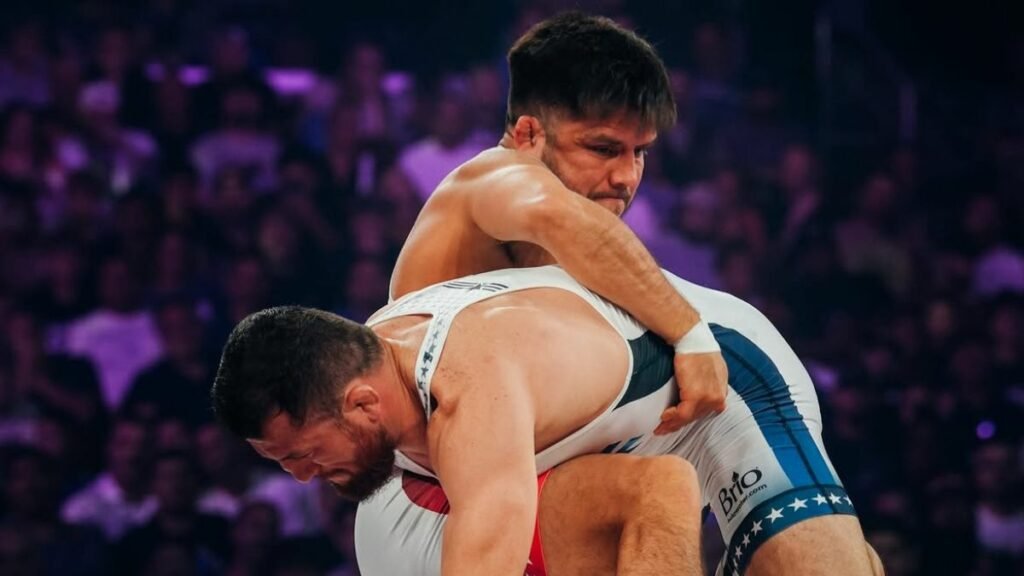
The fight itself illustrated that message with remarkable clarity. From the opening exchange, Cejudo imposed his wrestling, taking Dvalishvili down before immediately capitalizing on an opening to secure the pin. The referee stopped the contest almost instantly, but the significance of the victory extended well beyond its speed. It represented a return to the competitive identity that had defined Cejudo long before he became a two-division UFC champion.
The result becomes even more meaningful when viewed alongside their first meeting. In that contest, Cejudo built an early 8-0 lead before Dvalishvili stormed back through relentless pace and superior endurance. At the time, the comeback highlighted the Georgian’s remarkable conditioning, but it also exposed something Cejudo would later acknowledge himself: he had drifted away from the Olympic wrestling identity that once separated him from everyone else.
Speaking after the fight, Cejudo offered no excuses. Instead, he revealed that he had isolated himself for nearly six weeks in upstate New York, dedicating himself entirely to training. He also recalled a conversation with Israel Adesanya, who once told him that when Cejudo is truly at his best, no one can beat him. Rather than treating those words as praise, he turned them into motivation. His conclusion was simple: the problem had never been his ability, but his gradual departure from the version of himself that had built his legacy.
Perhaps his most revealing admission concerned the evolution of his own career. After thirteen years focused primarily on MMA, Cejudo acknowledged that he had unintentionally neglected wrestling. In his view, the first loss to Dvalishvili was not evidence that the Georgian was the superior wrestler. Instead, it reflected what happens when a fighter with relentless cardio dictates the pace against an opponent who has moved away from his strongest fundamentals. By saying he was never surprised by that defeat, Cejudo reframed it as the logical consequence of his own choices rather than an unavoidable reality.
That perspective carries a broader message than simple post-fight analysis. Cejudo argues that championships and Olympic medals do not preserve themselves. A fighter’s identity must be maintained through constant practice. His return to wrestling therefore represents less a nostalgic comeback than a deliberate reconstruction of the competitive principles that made him exceptional in the first place. In his view, champions do not lose their greatness when they lose a fight—they lose it when they abandon the qualities that created it.
Although Cejudo openly welcomed the possibility of a trilogy with Dvalishvili, that chapter appears destined to wait. His immediate future lies inside a boxing ring, where he is scheduled to face Nurideen Shabazz under the Misfits Boxing banner, continuing his willingness to test himself across different combat sports.
Meanwhile, Dvalishvili remains fully focused on his trilogy bout with Petr Yan at UFC 333, where he hopes to reclaim the bantamweight championship he lost at the end of 2025. Their careers are therefore moving in different directions for now, leaving the prospect of a third meeting on hold until competitive circumstances bring them together again.
Ultimately, Cejudo’s 36-second victory was far more than another win on his résumé. It represented a reassessment of his entire competitive identity. His real message was not simply that he had defeated Merab Dvalishvili—it was that his greatest weapon had never vanished. He simply chose to become the wrestler who had made him a champion in the first place.