


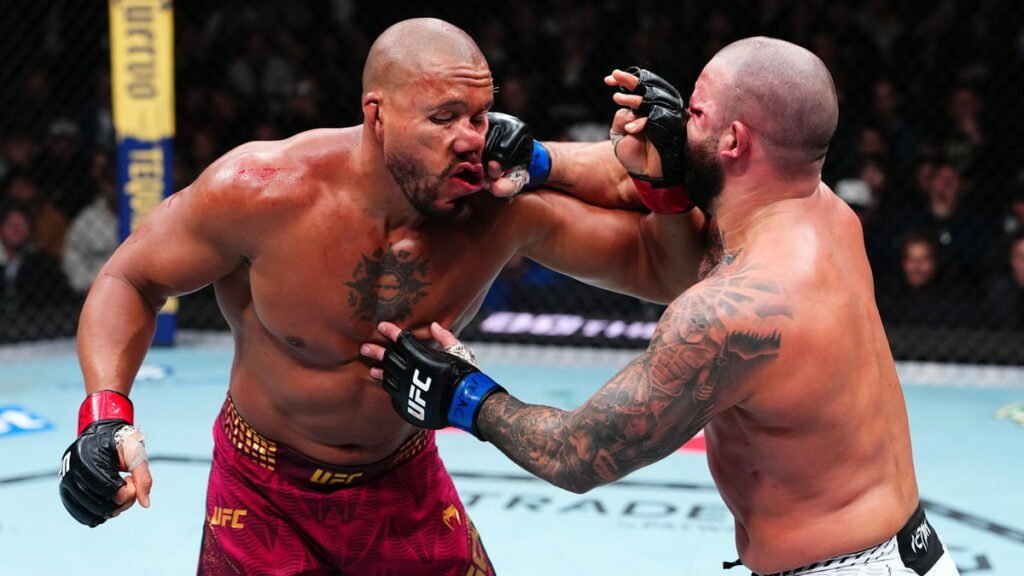
Ciryl Gane’s title defense against Josh Hokit was never going to be a routine assignment. For the French champion, this fight represented a different kind of test: an opponent determined to take away his technical comfort zone, eliminate his room to move and turn the contest into a sustained physical battle.
Across five rounds of relentless pressure, wrestling exchanges and demanding physical exchanges, Gane was forced to operate under conditions that did not suit his usual approach. When the fight was over, the Frenchman secured a unanimous decision victory (48-47, 48-47, 48-47), retained his heavyweight championship and handed Hokit the first professional defeat of his career.
Yet looking at this fight solely through the result would overlook what it actually revealed. Gane kept his belt, but he was forced to leave the environment in which he usually thrives: controlling distance, managing the pace and dictating exchanges through movement and precision.
From an unusual path to the championship to the responsibility of defending it
Ciryl Gane entered this contest as the undisputed heavyweight champion after a series of events that had significantly reshaped the division.
Following his no-contest bout against Tom Aspinall at UFC 321, which ended after an accidental eye-poke sequence, the Frenchman went on to capture the interim championship with a TKO victory over Alex Pereira at the White House event. Aspinall’s subsequent withdrawal and decision to vacate the title then elevated Gane to undisputed champion.
It was a major development in Gane’s career, but winning a championship and defending it are two very different challenges. Winning proves that a fighter can reach the top. Defending it means dealing with opponents who are not necessarily interested in matching his strengths, but in disrupting his game and forcing him into situations where those strengths become less effective.
Josh Hokit arrived in New York undefeated, with the ambition of changing the established order in the heavyweight division. Although he entered as the less favored challenger, the American showed little interest in approaching the fight cautiously. From the opening seconds, he made pressure and pace the foundations of his strategy.
Hokit dictates the terms as Gane searches for his range
From the first round, Hokit’s intentions were clear. He was not going to allow Gane the space needed to establish his striking rhythm. The American immediately looked for takedowns, mixing wrestling entries with striking attacks and constant forward movement.
Gane attempted to respond with the tools that have defined his best performances: the jab, straight punches, uppercuts and backward movement. But the problem was not his ability to land. It was his difficulty in stopping his opponent’s forward momentum.
Hokit was willing to absorb strikes in exchange for closing the distance and turning technical exchanges into repeated physical confrontations. At one point, he managed to lift Gane and slam him heavily in the center of the cage, drawing a strong reaction from the crowd.
WE GO TO THE CHAMPIONSHIP ROUNDS 👀
[ #Polymarket #UFC334 | LIVE NOW on @ParamountPlus ] pic.twitter.com/JET26tLrUB
— UFC (@ufc) November 15, 2026
That sequence was more than a display of strength. It was a clear tactical statement: Gane would not be allowed to manage the fight through boxing and distance control alone.
The second round followed much of the same pattern. Hokit continued looking for wrestling opportunities, while Gane attempted to build combinations while moving backward. The American, however, showed an impressive ability to absorb punishment and keep advancing. He also managed to land on the champion’s face, opening a cut.
The difference between the two fighters was therefore about more than the number of strikes thrown. Gane was looking for clean, structured exchanges to score. Hokit wanted every exchange to become another stage in a physical battle, one that would leave his opponent with little opportunity to recover.
Round three: when technical superiority becomes a battle of attrition
By the third round, the central question was no longer simply who could land the cleaner punches. It was also about which fighter could maintain his effectiveness under a pace dictated by the other.
Hokit continued pressing forward, looking for clinch situations and wrestling exchanges. He managed to bring Gane to the ground and briefly take his back before the two fighters returned to their feet.
Although Gane managed to get back up, those sequences exposed the structure behind Hokit’s strategy. The American was not simply rushing forward without a plan. He was alternating pressure, wrestling and close-range exchanges to make every minute increasingly expensive for the champion.
Gane, meanwhile, maintained a degree of technical composure and continued landing accurately. But his movement and freedom of action were no longer as fluid as they had been in some of his previous performances.
This was one of the defining aspects of the fight: Hokit did not need to win every exchange. His objective was to gradually reduce Gane’s ability to impose his own rhythm. Every takedown attempt, every clinch against the fence and every forward advance added another physical demand on the champion.
Hokit’s fight was built around exhausting space, time and energy. Gane’s challenge was to preserve his accuracy and effectiveness despite having fewer opportunities to move freely.
Rounds four and five: Gane finds solutions in the middle of the storm
As the fourth round began, signs of fatigue became increasingly visible. But the more significant development was the way Gane started adapting to the pressure being imposed on him.
Rather than constantly trying to restore long-range exchanges, the Frenchman became more willing to work at close range, using uppercuts and body shots. He also had to deal with clinch situations against the cage, an area Hokit repeatedly sought to exploit.
This was not a complete change of style. It was an adjustment to the conditions of the fight. Gane did not abandon his technical identity, but he appeared to recognize that insisting on fighting exclusively at range would expose him to further physical exhaustion.
In the fifth round, Hokit returned to his takedown attempts almost immediately. This time, however, Gane defended the wrestling entries more effectively and tried to maintain offensive activity through his jab and uppercuts.
Despite the fatigue, the Frenchman continued varying his attacks between the head and body. Hokit was still moving forward, but his offensive effectiveness appeared to have diminished compared with the opening rounds. Gane, meanwhile, managed to recover some of his initiative.
The final round was therefore more than a battle for points. It was a test of the ability to regain control after spending much of the contest under sustained pressure. Gane’s experience in managing distance and close-range exchanges played an important role during this decisive phase.
The judges’ decision: a deserved victory that does not eliminate the questions
After five rounds, the judges awarded Ciryl Gane a unanimous decision, with three identical scorecards of 48-47.
The result reflected how closely contested the fight had been, particularly because the two fighters offered different criteria for evaluating their success. Hokit managed to impose periods of pressure and wrestling control, while Gane maintained the ability to land cleaner and more accurate strikes at important moments.
The final two rounds, in particular, allowed the Frenchman to regain more initiative as his opponent’s offensive effectiveness appeared to decline.
Gane therefore retains his championship, but this victory should not be mistaken for unquestioned dominance. Hokit demonstrated that he could impose a genuine physical challenge on a champion of this level. He lost his undefeated record, but also showed that his emergence as a title contender was not simply the product of momentum or attention.
What the fight revealed about Gane: being champion does not always mean dominating
The analytical value of this contest lies in the different picture it offered of Ciryl Gane.
The Frenchman has built much of his identity around movement, speed of execution and timing. These qualities give him a technical advantage rarely seen among heavyweight fighters.
But Hokit deliberately set out to test what happens when that space disappears. What remains of Gane’s game when he is repeatedly forced to defend wrestling attempts, manage clinch exchanges and deal with an opponent who refuses to give him a moment to reset?
The fight confirmed that Gane still possesses important offensive weapons, while his accuracy and ability to adapt remain among his greatest strengths. However, it also demonstrated that sustained pressure, combined with changes of level and wrestling exchanges, can put him in increasingly difficult situations.
That does not necessarily amount to an absolute weakness, but it is information future challengers will undoubtedly study. Anyone hoping to take his championship will need to find a way to close the distance, force him into clinch exchanges and test his ability to remain effective over five rounds.
As for Hokit, the defeat should not erase what he demonstrated. He managed to impose his pace against the world champion and turn the fight into an open physical confrontation. But he could not maintain the same level of effectiveness through the final stages. The difference between delivering a competitive performance and winning a championship sometimes comes down to energy management, not simply the willingness to engage in a difficult fight.
Gane’s praise for Hokit: recognition that goes beyond post-fight courtesy
Beyond the technical aspects, the moments following the fight also carried significance. Despite the tension and hostility surrounding the matchup, the two fighters exchanged greetings and congratulations after the result was announced.
Speaking to Joe Rogan, the French champion was quick to acknowledge his opponent’s qualities. Gane said Hokit had not surprised him, that he knew he was facing a difficult opponent, and pointed out that many people had underestimated the American.
“This guy is the future of this sport,” Gane said.
The statement carries particular weight considering the fight that had just taken place. The Frenchman did not need to justify his victory, but he chose to acknowledge that Hokit had given him a genuine test and that his previous record did not necessarily reflect the full extent of his abilities.
In a sport built around direct confrontation, recognizing an opponent’s quality is not always just a matter of post-fight courtesy. It can also reflect an understanding of the challenge faced and respect for the difficulties imposed inside the cage.
Keeping the belt does not close the heavyweight division’s case
Ciryl Gane’s victory at UFC 334 adds another chapter to his career, but it does not provide a definitive answer about his ability to dominate the heavyweight division over the long term.
The Frenchman demonstrated that he can survive an intense physical test and recover some initiative even after losing control of important portions of a fight. But the contest also confirmed that defending his championship will require him to deal with different challenges, particularly against opponents capable of combining wrestling, offensive pressure and the ability to absorb strikes.
Josh Hokit, meanwhile, loses his opportunity to become champion and suffers the first defeat of his professional career. But he leaves with something significant: proof that he can compete with the world champion over five rounds and impose a style that is particularly difficult to manage.
In the end, Gane keeps the belt and Hokit loses his undefeated record. But the fight leaves behind a question more important than the result itself: can the French champion continue developing his defensive responses against sustained pressure, or will other contenders attempt to replicate the formula that came close to disrupting his plans in New York?
The answer will not be found in the judges’ scorecards, but in his next fight. Ciryl Gane remains champion, but the road to keeping that championship has just become more demanding.