


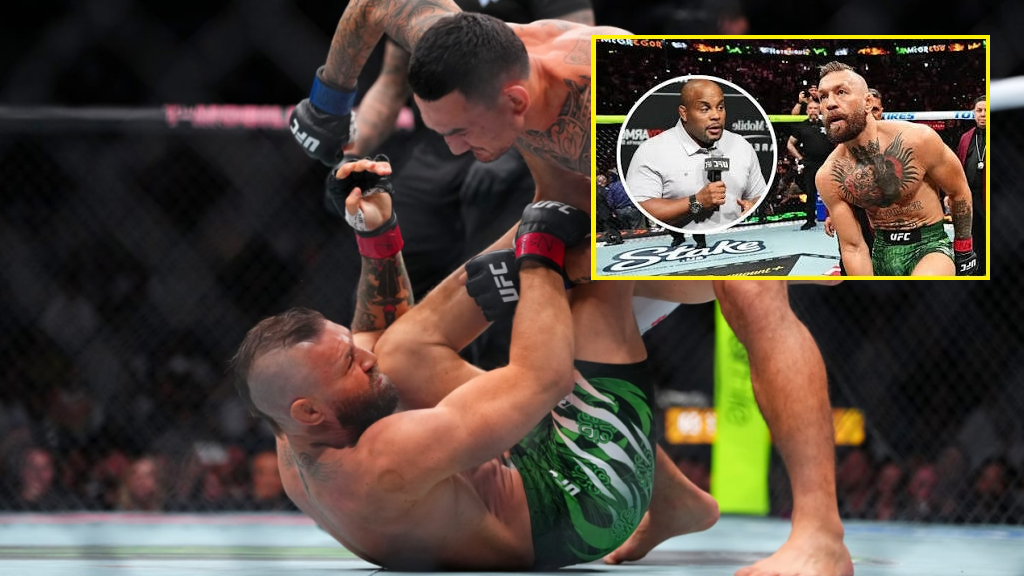
Conor McGregor’s defeat in the UFC 329 main event was far more than a disappointing sporting result. It raised deeper questions about the invisible battles elite athletes face when attempting to return to the highest level of competition. After five years away from active fighting, the Irish superstar stepped back into the Octagon carrying the weight of enormous expectations. Yet what was expected to become one of the biggest MMA events of the year ended in frustration, as the contest lasted little more than a minute before a leg injury abruptly brought his comeback to an end.
While many observers were quick to blame ring rust or the physical consequences of such a prolonged absence, former two-division UFC champion Daniel Cormier offered a far more nuanced interpretation. In his view, McGregor’s greatest opponent that night was not Max Holloway alone. It was the overwhelming emotional shock of returning to an environment unlike anything else in professional sports.
Cormier argues that television audiences can never fully appreciate what a fighter experiences during the walk to the Octagon. It is far more than entering an arena packed with thousands of spectators. It is an explosion of adrenaline where fear, excitement, pressure, anticipation, and survival instincts collide all at once. According to him, no adventure, business success, or life experience outside the cage can truly replicate that overwhelming psychological intensity.
From this perspective, Cormier believes McGregor’s five-year absence deprived him of the ability to regulate that unique emotional surge. That overload may have contributed to an impulsive decision in the opening moments—a risky offensive movement that ultimately resulted in the injury which ended the fight almost immediately. In Cormier’s assessment, fighters returning after lengthy layoffs often display actions that appear irrational because both their minds and bodies must readjust to a competitive intensity that cannot be fully recreated in training.
The analysis extends even further. Cormier suggests that despite McGregor’s extraordinary life outside the Octagon over the past five years—marked by global fame, financial success, business ventures, and constant media attention—none of those achievements could replace the unique feeling of genuine competition. For elite fighters, walking into the cage remains an irreplaceable experience capable of overshadowing everything they have accomplished beyond the sport.
This perspective highlights a reality that is often overlooked in combat sports. A comeback after years away is not simply a physical challenge; it is equally a psychological one. Timing, decision-making, emotional control, and competitive instincts cannot be fully restored through confidence or reputation alone. They are sharpened only through repeated exposure to real competition. In that sense, a returning champion frequently fights his toughest battle against himself long before confronting the opponent standing across the cage.
For Conor McGregor, the loss to Max Holloway therefore represents far more than another defeat on his professional record. It may well become one of the defining crossroads of his career. His greatest challenge moving forward will not simply be rebuilding his physical condition, but rediscovering the psychological balance and competitive composure that once established him as one of the most influential and captivating figures in mixed martial arts history.
In the aftermath of UFC 329, one question continues to dominate the discussion: was McGregor’s defeat merely the consequence of an unfortunate injury, or did it expose a deeper reality? Perhaps the greatest battles champions fight are not always against the opponent standing in front of them, but against time, prolonged absence, and the powerful emotions that return with them the moment they step back inside the cage.