


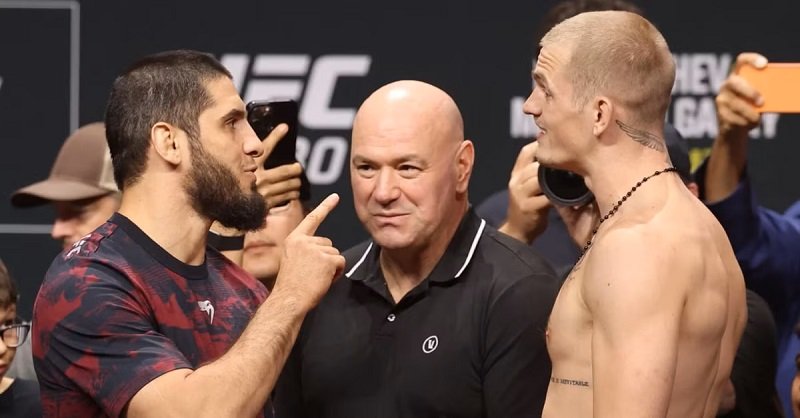
Just hours before the main event of UFC 330, the final exchange between Islam Makhachev and Ian Machado Garry was far more than a routine face-off staged for the cameras. It offered a revealing glimpse into two fundamentally different approaches to handling pressure and shaping public perception before a career-defining contest. The words exchanged were few, yet they exposed two contrasting philosophies of communication on the eve of one of the year’s biggest fights.
For Ian Garry, who is stepping into his first UFC title fight, the moment became an opportunity to declare a broader ambition. By opening with the acknowledgment that Islam Makhachev is the best fighter in the world today, the Irish challenger appeared to pay tribute to the reigning champion. Beneath that respect, however, lay a carefully constructed narrative. If he defeats the man widely recognized as the pound-for-pound king, no one will be able to diminish the significance of his victory. His message was therefore aimed not only at introducing a title fight, but at legitimizing the reign he believes is about to begin.
That strategy became even clearer when Garry described the bout as a meeting between “two of the greatest fighters in the history of the sport.” The statement went well beyond confidence or self-belief. It was an attempt to place himself inside the sport’s historical narrative before the cage had produced its verdict. This has become a familiar formula in modern combat sports: transform a championship fight into a defining historical event so that the athlete becomes part of the legend before earning it through victory.
The speech also reflected Garry’s understanding of the UFC’s media ecosystem. Championships alone are no longer enough to build global superstardom; they must be accompanied by a compelling story. Rather than dwelling on technical preparations or tactical details, Garry focused on legacy, dominance, and the future. His audience extended beyond Islam Makhachev to include the fans, the media, and the promotion itself. He sought to make the idea of his rise to the top feel inevitable before it had actually happened.
Islam Makhachev chose an entirely different path. The champion showed no interest in matching his opponent’s rhetoric or engaging in a battle of words. Instead, he delivered a brief and direct message: “He is my next target. I’m ready, and tomorrow I’ll make these people happy.” That restraint should not be mistaken for a lack of confidence or emotion. Rather, it reflects an identity that has defined Makhachev throughout his career—minimizing external noise and allowing performance inside the Octagon to become the only language that truly matters.
This approach is entirely consistent with Makhachev’s journey. As the standard-bearer of the system built by Abdulmanap Nurmagomedov and later embodied by Khabib Nurmagomedov, he has consistently favored efficiency over theatrics. The underlying message remains unchanged: the louder an opponent becomes outside the cage, the stronger the response should be once the cage door closes. His objective was never to win the press conference, but to preserve complete focus for the fight itself.
The contrast between the two fighters also reflects the different positions they occupy in their careers. Ian Garry needs to elevate the symbolic value of this contest because victory would instantly transform him into the new face of the welterweight division. Islam Makhachev, by contrast, no longer needs to establish his status—he is defending it. Every public appearance is less about building a reputation than protecting a legacy forged through sustained excellence and a reign that has placed him at the summit of the pound-for-pound rankings.
Behind what appeared to be a simple exchange lies a deeper confrontation than a championship bout alone can explain. Ian Garry represents a generation that views media storytelling as an essential extension of athletic competition. Islam Makhachev embodies a school of thought that believes legitimacy is earned through discipline, consistency, and results rather than headlines. One seeks to write the future through words; the other prefers to let achievements speak on his behalf.
As UFC 330 approaches, these final remarks have not revealed who will emerge victorious. They have, however, offered a remarkably clear portrait of the mindset each man brings into the Octagon. Garry is attempting to launch his era from behind the microphone, while Makhachev quietly reminds everyone that championships are never won at press conferences. In the UFC, words can shape expectations, but only the closing of the cage door determines whether those promises become history.