


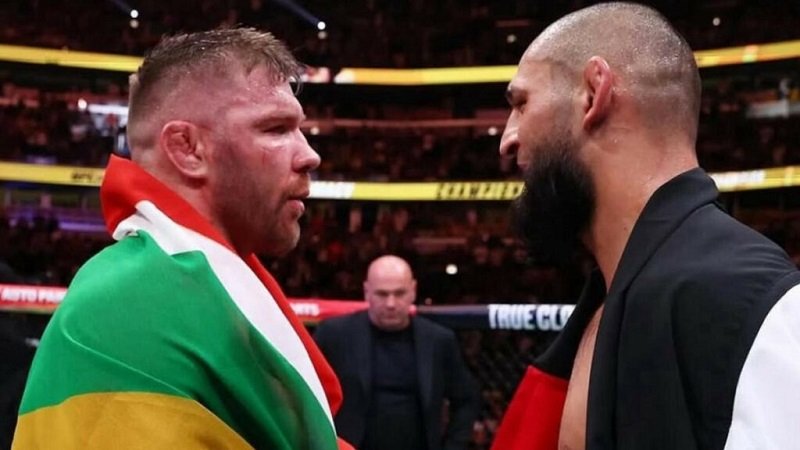
In the world of mixed martial arts, fights rarely end when the cage door closes. What follows is often another battle—one fought through narratives, analysis, and the strategic reinterpretation of what happened inside the octagon. This dynamic resurfaced recently when former middleweight champion Dricus Du Plessis revisited his first encounter with the relentless Chechen contender Khamzat Chimaev, offering a reflection that blends self-criticism, confidence, and a subtle attempt to reshape the story of that defeat.
After months without a fight, attention has once again turned to the middleweight hierarchy within the Ultimate Fighting Championship. The announcement that Chimaev will return in the main event of UFC 328 against former champion Sean Strickland has reignited debate across the MMA community. In France in particular, many observers believe that rising contender Nassourdine Imavov had a stronger claim to the next title opportunity based on recent performances, adding another layer of controversy to the matchmaking decision.
Against this backdrop, Du Plessis chose to reopen the discussion about his clash with Chimaev—a bout that, on the surface, appeared decisively controlled by the Chechen fighter over five rounds. Chimaev’s suffocating wrestling pressure and positional dominance effectively neutralized much of the South African’s offensive arsenal, leaving little room for Du Plessis to impose his typically chaotic and aggressive striking style.
Yet the South African’s retrospective reading of that fight paints a more nuanced picture. According to Du Plessis, the gap between them was not as wide as the fight seemed to suggest. In his view, Chimaev was superior in only a small fraction of the overall MMA skill set. “He was better than me in about 10 percent of MMA,” he stated—an assertion that shifts the focus from a technical mismatch to what he frames as a strategic and tactical defeat.
This perspective reveals a layer of self-assessment rather than simple bravado. Du Plessis implicitly acknowledges that Chimaev’s wrestling—the very dimension that defined the bout—was the decisive factor. Since then, he claims, that specific weakness has become a central focus of his preparation, suggesting a deliberate effort to close the gap in the one area that tilted the balance of power.
More strikingly, the South African now projects confidence that in a potential rematch he could not only neutralize Chimaev’s grappling threat but also compete with him on his own terrain. It is an ambitious claim in a division where the margins between victory and defeat are often determined by the smallest tactical adjustments.
However, reclaiming a path toward the title will likely require Du Plessis to pass through another high-stakes test. In that scenario, the name of Nassourdine Imavov emerges once again as a compelling possibility. A matchup between the two could serve as a pivotal crossroads for the middleweight division—particularly if such a fight were staged in Paris, a location that would add both symbolic and promotional weight to the contest.
Ultimately, Du Plessis’s remarks highlight a fundamental reality of modern MMA: the psychological and narrative dimensions of the sport have become nearly as significant as the physical confrontation itself. In a landscape shaped by perception, momentum, and public discourse, a defeat is rarely the final chapter. More often, it becomes the opening scene of a story about adaptation, redemption, and the relentless pursuit of a second chance.