


With only seconds remaining at UFC 300, Justin Gaethje knew his options were running out. Against Max Holloway, the fight appeared to be slipping away on the scorecards, leaving him with the fifth and final round to change the outcome before the judges made their decision. That was when Gaethje accepted Holloway’s invitation to meet in the center of the cage — a decision that, seconds later, became one of the most memorable moments in recent UFC history.
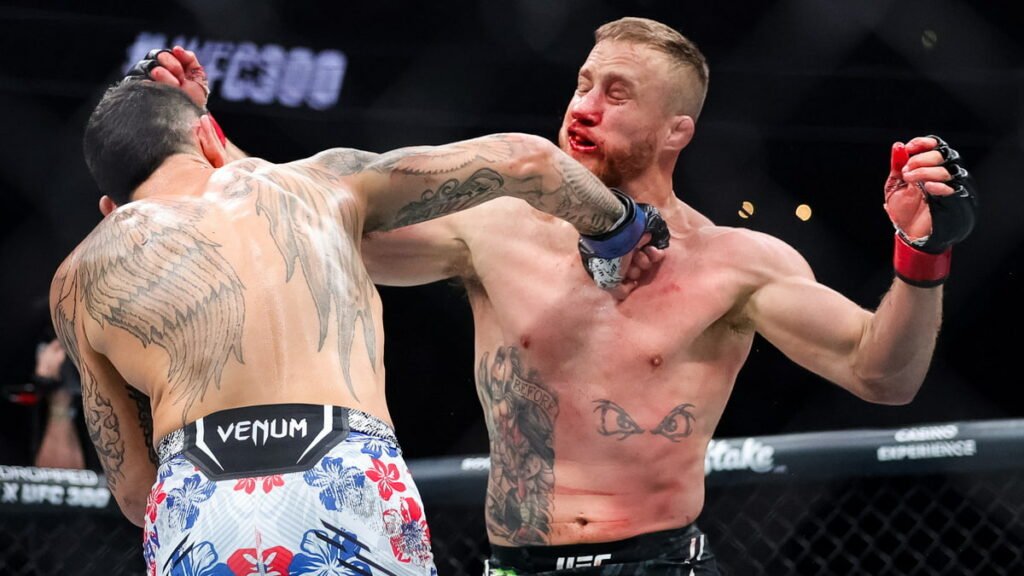
On April 13, 2024, at UFC 300, the two men had gone nearly 24 minutes before everything changed in the closing moments. Holloway called Gaethje toward the center of the Octagon, and the American accepted. After a brief exchange, with only one second remaining, “Blessed” landed a right hand that knocked Gaethje out. The fight was over.
The moment quickly became bigger than the result itself. It also captured the level of risk Gaethje was willing to accept at that precise point: leave the outcome to the judges, or chase a finish that could have allowed him to turn the fight around and retain the BMF title. With hindsight, his decision is easier to explain. Inside the cage, however, it was a choice made under the pressure of a final round.
Gaethje now says he believed he was behind on the scorecards heading into the fifth. From his perspective, simply reaching the final bell and hoping to overturn the fight through the judges did not represent his best opportunity. He needed to create something that could change the direction of the contest.
“For me, that was my only chance to win. I wasn’t going to give up like a b****,” Gaethje said on the One Night with Steiny podcast.
That statement helps explain why Holloway’s invitation did not register for Gaethje as merely a moment of showmanship. It came at a time when he was already looking for an opening that could produce a finish. The center of the cage therefore became the place where the fight could swing in either direction.
Holloway got the exchange he was looking for. The two fighters stood face-to-face in a moment that would later become iconic, before the Hawaiian unleashed his final shot in the closing seconds. Gaethje went down, losing the BMF belt while Holloway secured one of the victories most closely associated with spectacular UFC finishes.
More than two years later, that defeat belongs to a very different stage of Gaethje’s career. Since UFC 300, he has collected important wins over Rafael Fiziev, Paddy Pimblett and Ilia Topuria, eventually returning to the top of the lightweight division and capturing the undisputed belt.
The contrast is striking: the same fighter who accepted a high-risk exchange while believing he was behind on the scorecards later found his way back to the top of the 155-pound division. Yet the Holloway fight still offers a clear glimpse into one of the defining features of Gaethje’s career: when a fight forces him to choose between managing risk and creating an immediate ending, he has often leaned toward the latter.
On that night, the gamble did not work. When Holloway’s punch landed, there was only one second left on the clock — and no time left for Gaethje to change the course of the fight.