


On what seemed like an ordinary American evening, beneath the cold lights of California and in front of millions of Netflix screens around the world, a young man from the French suburbs stepped into the cage as if he were walking into an examination room before the entire world. This was not merely another fight on the first-ever MVP MMA card. It was a symbolic moment revealing something much deeper: how a fighter emerging from Europe’s social margins is now attempting to conquer the center of the global combat sports industry.
That night, Salahdine Parnasse was not only fighting the American Kenneth Cross. He was also confronting the brutal logic of the American fight business itself — a system that recognizes only one truth: the ability to transform a few minutes of controlled violence into a global image powerful enough to dominate attention.
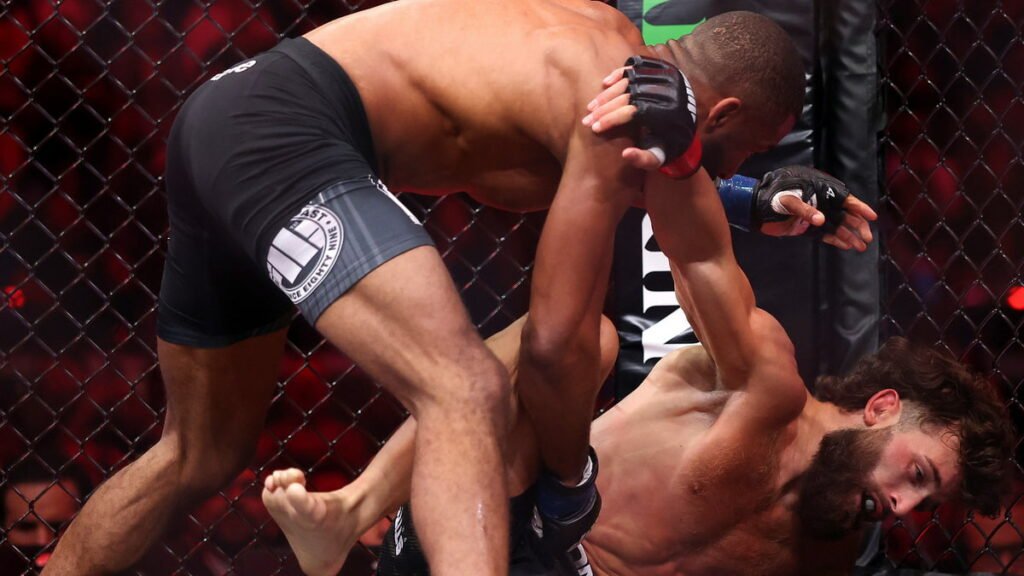
From the opening seconds, the Frenchman looked as though he fully understood the codes of this new world. He caught the middle kick, imposed his ground and pound, reversed the wrestling exchanges, and walked forward with a calm, calculated pressure that made the gap between Europe and the United States seem nonexistent inside the cage. Yet beyond the technical display was something even more important: psychological control. In America, winning alone is never enough. A fighter must create a moment, a viral sequence, an unforgettable visual capable of surviving long after the fight itself ends.
The devastating body shot that finished the bout was therefore more than a knockout. It felt like an official declaration of arrival onto the global market. By leaving KSW — where he built his reputation as a two-division champion — Parnasse did not simply switch organizations. He entered another dimension entirely. Moving from Europe to the American MMA market means evolving from being a successful athlete into becoming a global entertainment product shaped by streaming platforms, digital algorithms, and the ruthless economy of attention.
That is precisely why this victory carries a significance far beyond the sporting result itself. The fact that the fight aired on Netflix is not a minor detail. It confirms that MMA is no longer just a niche sport reserved for hardcore fans. It is becoming a worldwide entertainment industry capable of transforming fighters into international figures within a single night. Today, a fighter’s value is no longer determined solely by titles and records, but also by the ability to generate emotion, viral clips, online engagement, and digital conversation.
Behind this individual success lies an even deeper social reality. Over the past decade, combat sports have increasingly become a new form of social mobility for young people from working-class neighborhoods. Where football once represented the only imaginable escape, MMA now offers another path: the possibility of visibility, recognition, and economic elevation through discipline, violence management, and spectacle.
That is what makes trajectories like Salahdine Parnasse’s so symbolically powerful. They tell a story larger than that of a single champion. They reflect an entire generation attempting to force open the doors of a global system that remains extremely selective. And while the United States continues building massive entertainment platforms capable of creating global stars overnight, many countries still manage combat sports through fragile institutions, internal conflicts, and outdated amateur mentalities.
In the end, this first-round knockout tells a story far bigger than a quick victory. It reveals how combat sports have evolved into a universal language of success, visibility, and social survival. And it leaves behind a more unsettling question: how many extraordinary talents remain trapped inside systems incapable of understanding that modern champions are no longer created only inside cages, but also through media power, education, neighborhoods, and national strategies capable of transforming a fighter into a global symbol?