


The greatest victories in combat sports are rarely defined by the final punch or the image of a championship belt being wrapped around a fighter’s waist. More often, they are built through countless subtle moments that escape the audience during the chaos of battle, only revealing their true significance when the fight is watched again with a cooler eye.
That is exactly what led Joe Rogan to revisit Justin Gaethje’s stunning victory over Ilia Topuria at UFC Freedom 250. While much of the conversation focused on the shock of seeing the previously unbeaten champion suffer the first loss of his professional career, Rogan believes the decisive factor received far less attention: the cumulative damage Gaethje inflicted on Topuria’s face while continuing to absorb punishment without ever abandoning his relentless pressure.
Held at the White House, the event was historic long before the opening bell. Yet once the cage door closed, the symbolism disappeared and only reality remained. Virtually every prediction favored Topuria. Analysts praised his technical superiority, bookmakers installed him as a clear favorite, and many expected another dominant title defense. But mixed martial arts has always reminded observers that probability ends where combat begins.
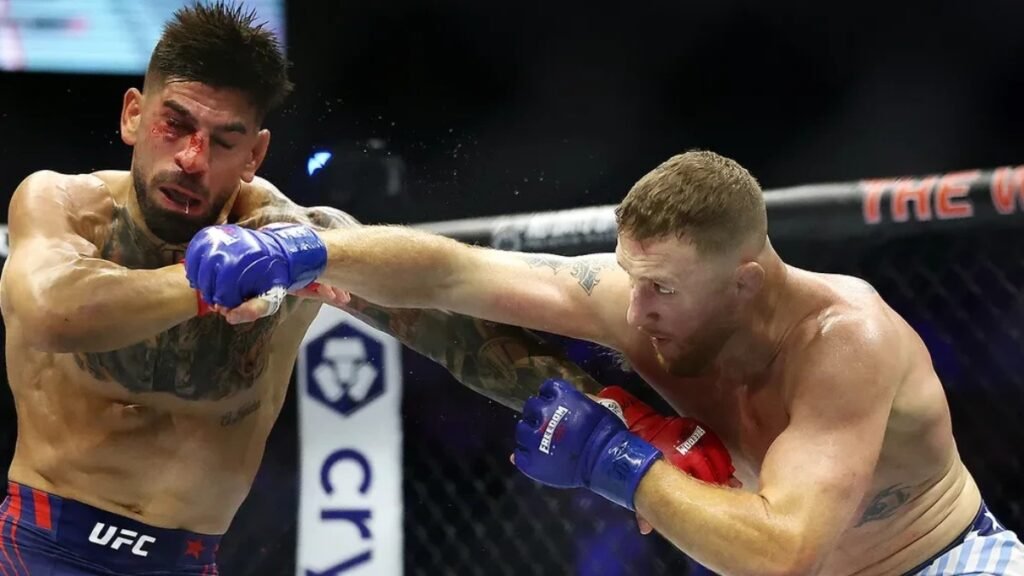
After reviewing the contest, Rogan concluded that Gaethje won a battle that was almost invisible in real time—the war of accumulation. Topuria landed devastating body shots, particularly to the liver, but Gaethje consistently answered with strikes that progressively damaged his opponent’s face. The cuts, swelling, and bleeding were not merely cosmetic injuries; they gradually altered Topuria’s vision, timing, and decision-making inside the cage.
Facial damage carries a strategic value that is often underestimated in mixed martial arts. A swollen eye narrows peripheral vision. A broken nose disrupts breathing. Persistent bleeding distracts focus. None of these injuries necessarily ends a fight immediately, yet together they slowly erode a fighter’s effectiveness until every exchange becomes more difficult than the last.
Rogan also referred to unconfirmed reports suggesting that Topuria may have suffered fractures to both orbital bones as well as a broken nose. While emphasizing that these claims had not been officially verified, he was struck by the remarkable contrast between the two athletes only days later. Topuria appeared to have endured the physical consequences of a brutal war, while Gaethje looked surprisingly healthy despite having absorbed tremendous punishment himself.
That durability has defined Justin Gaethje throughout his career. Rather than avoiding damage, he has consistently built his success around surviving it. His fighting philosophy is rooted in attrition—the belief that if both men are forced into a battle of endurance, his opponent will eventually break first. It is a dangerous strategy, one that exposes him to enormous risks, but against one of the sport’s most complete champions, it once again proved effective.
Beyond crowning a new lightweight champion, the fight revived a much broader question about elite competition. In an era increasingly dominated by analytics, biomechanics, performance metrics, and predictive models, how much value still belongs to qualities that cannot be measured? No statistic can fully capture resilience. No algorithm can quantify the willingness to keep fighting when the body is approaching its limits.
The fight also exposed the limitations of pre-fight predictions. Rankings, odds, and technical evaluations remain valuable tools, but they cannot account for the unpredictable psychological and physical variables that emerge once two world-class athletes are locked inside the cage.
At the same time, this defeat should not diminish Ilia Topuria’s legacy. Every great champion eventually faces adversity, and one loss does not erase years of excellence. According to his team, his recovery is progressing well, raising the possibility of a return before the end of the year if rehabilitation continues as expected.
Ultimately, Joe Rogan sees this victory as something greater than an upset or a championship changing hands. He sees it as a reminder that elite fighting is not always won by the athlete who lands the flashiest strike, but by the one who continues inflicting meaningful damage while refusing to surrender to pain.
And perhaps that leaves the sport with its most compelling question of all: in an age where technology measures almost everything, will the greatest champions always be defined by the one quality that remains beyond measurement—the extraordinary human capacity to endure?