


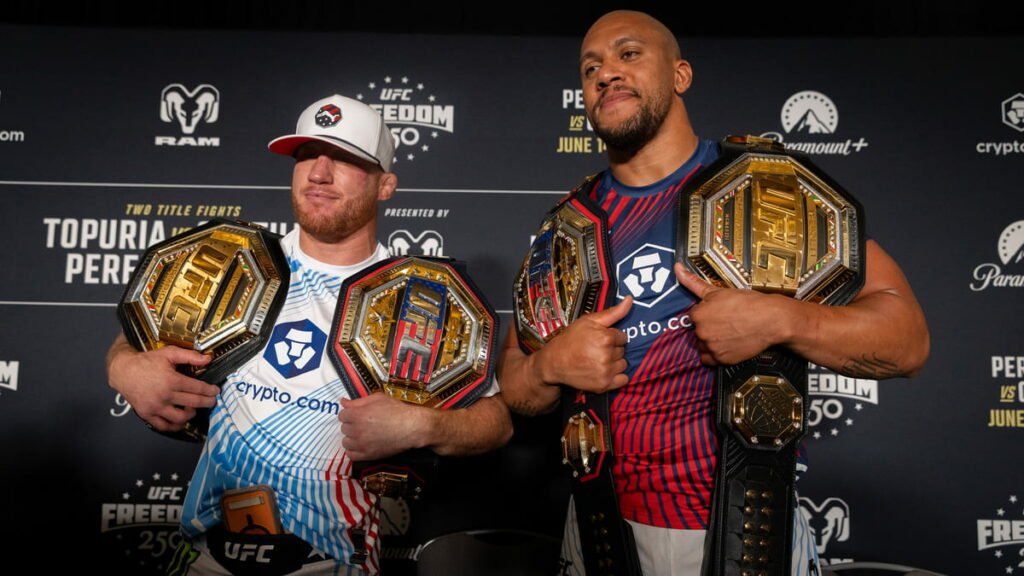
The UFC Freedom 250 event, staged in one of the most symbolic settings imaginable on the White House lawn for the 250th anniversary of the United States, was far more than a sporting showcase. It marked a moment where MMA stepped into a new dimension — one where sport, politics, and historical symbolism intersect on an unprecedented scale. Within this atmosphere, two fights reshaped the global hierarchy of the sport’s most prestigious divisions.
On one side, Ciryl Gane delivered a statement victory against Alex Pereira, finishing the fight by TKO in the second round and instantly reigniting his path toward heavyweight title contention. On the other, Justin Gaethje produced one of the most shocking outcomes of the year by stopping Ilia Topuria in a violent, high-intensity battle that shattered the aura of invincibility surrounding the Georgian-Spanish champion.
Yet beyond the outcomes inside the cage, it was the reaction from key figures that added another layer of meaning to the night. Francis Ngannou, former UFC heavyweight champion, responded publicly with comments that went far beyond routine congratulations. His posts reflect a deeper understanding of what unfolds at the elite level of combat sports — a space he knows intimately.
By praising Ciryl Gane, Ngannou was not simply offering polite acknowledgment. Their shared history inside the octagon gives this reaction a particular weight. Ngannou understands Gane’s strengths and limitations better than most observers, and that familiarity makes his recognition especially significant. Gane’s victory over Pereira is not just a win; it is a re-entry into the global title conversation in a division where every fight reshapes legitimacy.
Ngannou’s reaction to Justin Gaethje’s win is even more telling. His statement — warning never to bet against “The Highlight” — captures a core truth of MMA: unpredictability is its defining law. Gaethje represents the rare fighter who consistently defies statistical expectations, narrative cycles, and career predictions.
His victory over Topuria is therefore not just an upset; it is a disruption of a carefully constructed championship narrative. Topuria had been positioned as the face of a new generation — a fighter built on technical sharpness, explosive power, and modern promotional storytelling. His defeat forces a reassessment of how fragile dominance truly is in contemporary MMA.
What this night ultimately reveals is how modern fighters are no longer just competitors but also architects of the sport’s narrative. Ngannou himself has evolved into more than a former champion — he is now an influential voice shaping how events are interpreted globally. His reactions carry weight because they come from someone who has experienced both the summit and the rupture of elite competition.
Within this framework, his simultaneous acknowledgment of Gane and Gaethje becomes almost philosophical. It reflects a core reality of fighting sports: greatness is not defined solely by victory, but by endurance, reinvention, and the ability to resist predetermined outcomes.
The White House event will therefore be remembered not only for its spectacular results — seven KO/TKO finishes in as many fights — but also for what it reveals about the current state of MMA: a sport where certainties collapse as quickly as they are built.
Ultimately, Ngannou’s reflection raises a question that goes beyond wins and losses. It challenges the very idea of permanence in a sport where every fight can rewrite history. And perhaps true power in MMA is no longer about being untouchable — but about surviving the fall and returning to matter again.