


The Chinese octagon is no longer just another stop on the UFC calendar. For years, modern MMA dominance was closely associated with the Dagestani model built around Khabib Nurmagomedov — relentless pressure, suffocating grappling, collective discipline and mental control. But in Shanghai, a young Asian fighter delivered a different message: Asia no longer wants only to host the biggest names in combat sports; it wants to create them.
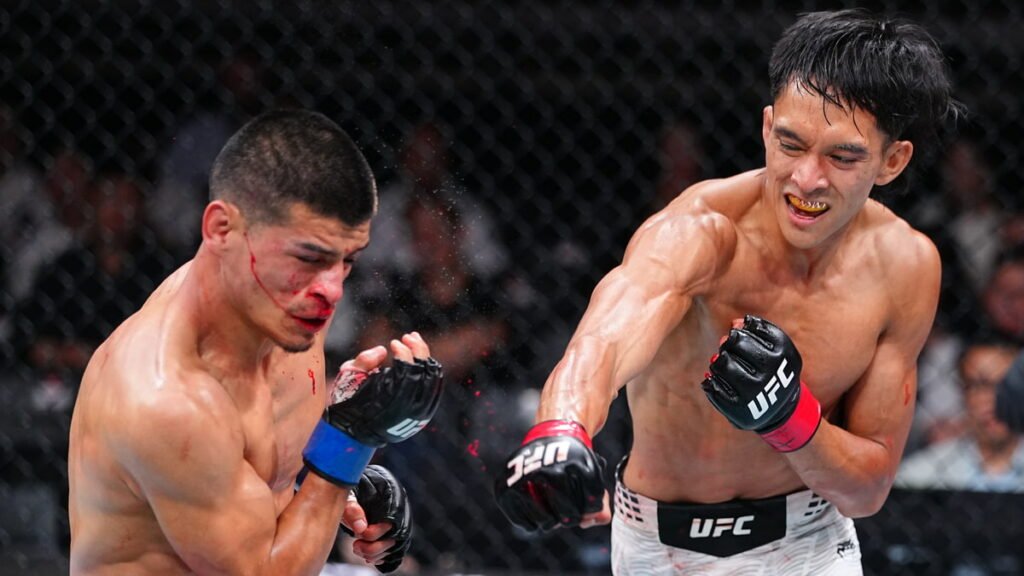
Bilal Hasan’s victory over Nilson Rojas was not simply a successful UFC debut. His spectacular knockout represented something larger. It was a moment where speed, confidence and personal identity came together — especially when Hasan celebrated with a moonwalk inspired by his idol Michael Jackson.
It was the image of a new generation of fighters who do not enter the cage only to win. They enter to build a story, a personality and a legacy of their own.
In Shanghai, under the UFC spotlight, 25-year-old Bilal Hasan made his first appearance inside the world’s biggest MMA organization. Across from him stood Nilson Rojas, an undefeated prospect, in a clash between two young fighters trying to establish themselves in the flyweight division.
Bilal Hasan moonwalks out the cage after securing the KO 😭 #UFCShanghai pic.twitter.com/H2nBbzLn6F https://t.co/WLkcM70hFk
— Championship Rounds (@ChampRDS) August 29, 2026
But the difference was not only the result.
It was the way it happened.
After a controlled opening round where he showed patience and tactical awareness, Hasan increased the pressure in the second. Standing in the center of the cage, he launched a high kick, moved around his opponent and then landed a powerful right hand that dropped Rojas. Seconds later, the referee stepped in to stop the ground strikes.
A quick victory — but one carrying a much bigger meaning.
From Khabib’s school to a world of multiple styles: is MMA’s center of gravity changing?
For years, Khabib Nurmagomedov represented more than a champion. He represented an entire fighting philosophy: constant pressure, physical domination, tactical intelligence and collective discipline.
The Dagestani school did not only produce champions. It created a blueprint that influenced the entire sport.
But MMA’s evolution cannot remain attached to one single formula.
The rise of Asian fighters such as Bilal Hasan reflects a broader transformation: the sport is moving from an era dominated by a few traditional regions toward a period where different fighting cultures can compete on equal ground.
Modern MMA no longer belongs exclusively to wrestling-based systems or historically dominant countries. New fighters combine local martial arts traditions, modern training methods, movement, striking and individual identity.
Hasan represents a different profile from the traditional image of a fighter relying only on physical dominance. His game is built around movement, timing, precision and the ability to create decisive moments.
The end of an era does not mean the disappearance of those who built it. It often means their model has become the foundation for those who come next.
China: from a massive market to a factory of champions?
Shanghai hosting this UFC event was not merely a logistical decision. China represents one of the largest sports markets in the world, and the UFC understands that its future expansion depends heavily on Asia.
But the real question is not only commercial.
It is whether Asia can produce fighters capable of competing at the highest level.
Asia has a deep martial arts history: kung fu, wushu, jiu-jitsu and countless traditional combat systems. The challenge has always been transforming that heritage into a modern MMA structure requiring a complete combination of wrestling, striking, conditioning and strategy.
The emergence of fighters like Hasan suggests that this transition is beginning to take shape.
Bilal Hasan: more than a number on a record
The statistics immediately stand out: a perfect professional record of 10-0, nine finishes, and another victory achieved only weeks after his knockout win on Dana White’s Contender Series.
But a fighter’s value is not measured only by numbers.
In a sport where building a personality is almost as important as winning fights, Hasan delivered a powerful introduction: a young Asian fighter, undefeated, stepping onto the biggest stage in the world, defeating another unbeaten prospect and adding a personal signature through a celebration connected to global pop culture.
A memorable image — built on a legitimate performance.
The future: are we witnessing a new Asian wave in the UFC?
It would be premature to declare the arrival of a new Asian MMA superpower based on one victory. Combat sports history is filled with fighters who started brilliantly before discovering the brutal demands of elite competition.
But what happened in Shanghai deserves attention as a signal.
If Asian countries continue developing professional training systems, and if major organizations keep investing in talent identification, a new generation could emerge in the years ahead.
Bilal Hasan did not announce the end of Khabib’s school. He did not prove that Shaolin or Asia will replace Dagestan.
MMA is far more complex than that.
But his victory revealed something important: the era of one dominant model is gradually giving way to an era of multiple schools.
Inside the cage, it was not only a fighter who scored a knockout.
It was a new generation knocking on the door.