


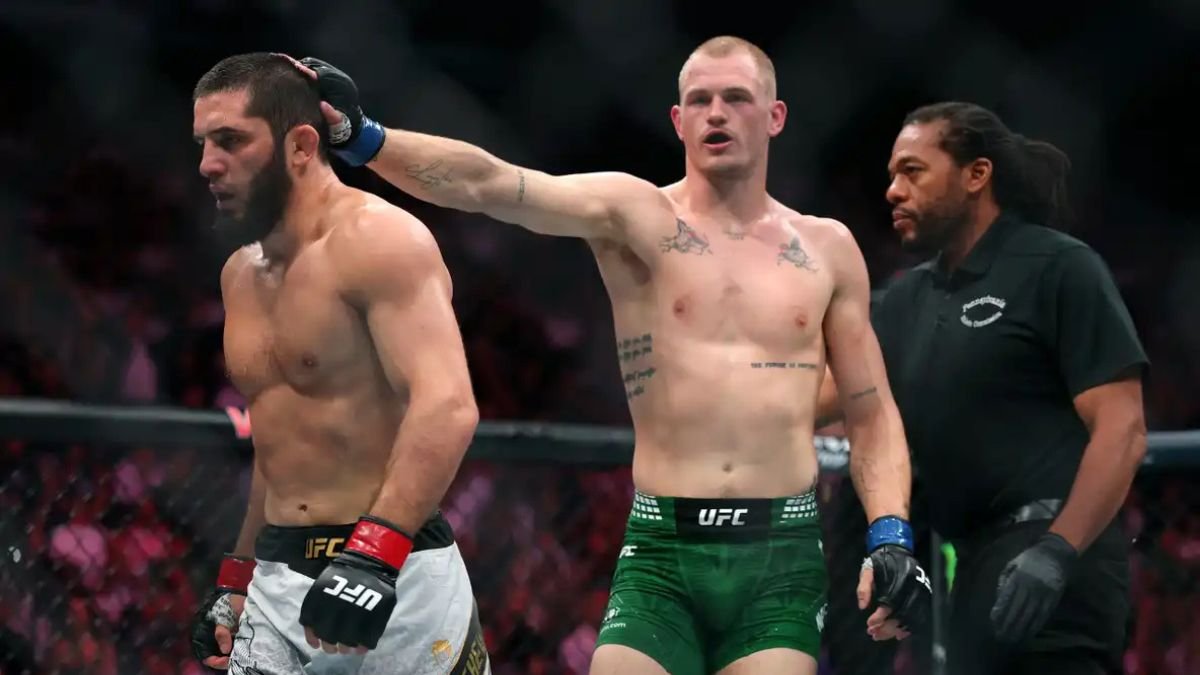
Islam Makhachev’s successful title defense in the UFC 330 main event did more than preserve his welterweight crown. It exposed a deeper reality: against the Dagestani champion, the fight begins long before the cage door closes. Ian Machado Garry survived all five rounds, yet the conversation afterward focused less on his durability than on the mindset he carried into a contest against a champion whose aura now seems to shape the battle before the opening exchange.
In his first welterweight title defense, Makhachev delivered the performance everyone has come to expect—relentless wrestling, suffocating positional control and an unmatched ability to dictate the pace until his opponent gradually ran out of answers. The unanimous decision victory extended a reign that is beginning to feel less like dominance and more like inevitability.
The most revealing analysis, however, came from two men who understand elite competition from experience: former title challenger Dustin Poirier, who has shared the cage with Makhachev, and Jorge Masvidal, one of MMA’s most outspoken voices.
For Poirier, the fight unfolded almost exactly as he had predicted. He even believed Makhachev might secure a submission, but what impressed him most was the champion’s ability to systematically drain Garry’s energy and confidence until control became absolute.
At the same time, Poirier credited the Irish contender for defending numerous takedown attempts and navigating difficult scrambling exchanges with intelligence, delaying what could have been an earlier finish.
Yet Poirier’s most compelling observation had little to do with technique. In his view, facing Islam Makhachev is first and foremost a psychological challenge. Many opponents build an almost mythical version of the champion in their minds before they ever touch gloves. Once the fight begins, they discover he is simply another human being. The problem is that this realization often comes too late, because Makhachev’s tactical dominance has already taken hold.
Masvidal approached the fight from an entirely different angle. For him, the issue was not Garry’s defeat but the message conveyed by his behavior throughout the contest.
“Gamebred” felt that Garry appeared happier to share the cage with Makhachev than determined to take his title. The repeated embraces, respectful gestures and words of admiration projected the image of a challenger honored by the occasion rather than one convinced he was there to become champion.
True to his uncompromising style, Masvidal argued that fans pay to witness fierce competition—not to hear challengers praise the reigning champion or celebrate his greatness. Respect has always been a cornerstone of combat sports, but, in his view, it should never overshadow the instinct to conquer.
Masvidal is far from alone in that assessment. Before him, UFC president Dana White and Makhachev himself questioned what they viewed as Garry’s overly respectful approach.
Ultimately, the discussion extends well beyond hugs or post-fight compliments. It raises a broader question about championship psychology. The greatest champions dominate not only through superior skills and physical ability but also through the psychological authority they impose on opponents before the first meaningful exchange even takes place.
When a challenger admires the champion’s greatness more than he believes in his own ability to dethrone him, part of the contest has already been decided before the opening bell.
Between Dustin Poirier’s measured analysis and Jorge Masvidal’s uncompromising criticism, one conclusion becomes impossible to ignore: Islam Makhachev is no longer winning solely because he is technically superior. He is winning because he now forces opponents to fight an internal battle before the physical one ever begins.
His dominance can no longer be measured only by championship belts or winning streaks. It is measured by something far more elusive—the ability to occupy an opponent’s mind before claiming the center of the Octagon itself.