



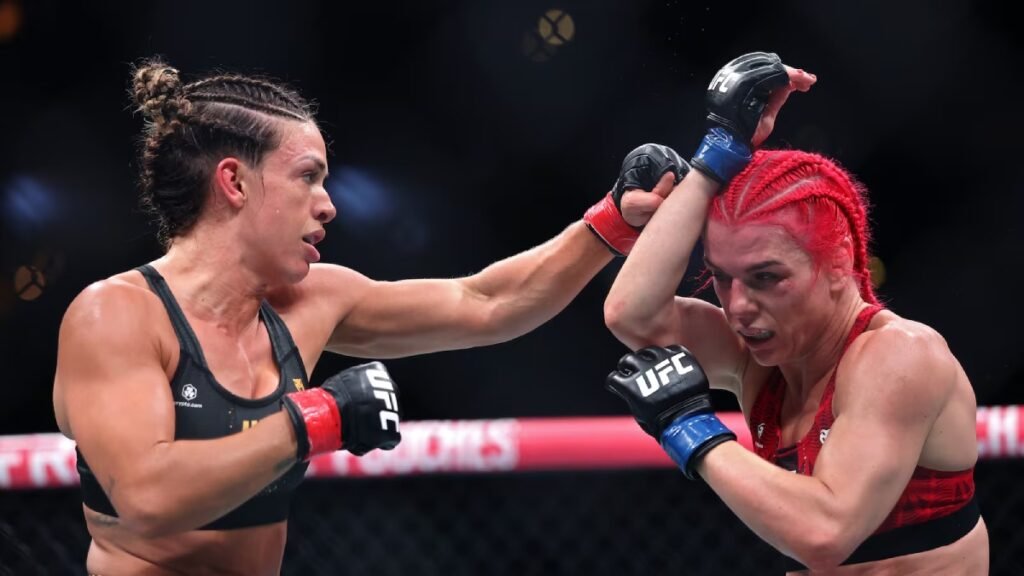
Mackenzie Dern successfully retained the UFC Strawweight Championship in the co-main event of UFC 330, defeating Gillian Robertson by unanimous decision after five composed and commanding rounds. The result settled more than the question of who would leave with the belt—it underscored the emergence of a champion who is no longer simply defending her position, but gradually redefining what sustained dominance looks like in one of the UFC’s deepest women’s divisions.
Heading into the contest, the spotlight naturally fell on a clash between two of the division’s most accomplished grapplers. Robertson entered with a reputation as one of the promotion’s most dangerous submission specialists, while Dern carried the credentials of a world-class Brazilian jiu-jitsu practitioner whose ground game has long shaped her identity inside the Octagon. The real question, however, was never who preferred fighting on the mat, but who possessed the tactical maturity to impose her game against an opponent equally comfortable in that territory.
From the opening exchanges, Dern established control over the rhythm of the fight. She consistently pressed forward, managed the distance with confidence, and denied Robertson the opportunity to build any sustained offensive momentum. Every attempt by the challenger to dictate the pace was met with calculated adjustments from the champion, whose superior tactical awareness ensured that each phase of the contest unfolded on her own terms.
The fight produced neither a spectacular submission nor a dramatic finish, but that was less a reflection of caution than of the elite technical level shared by both athletes. When two high-level grapplers meet, a single mistake can determine the outcome. Over twenty-five minutes, however, Dern systematically minimized those risks while steadily limiting Robertson’s options, making the judges’ decision feel like the natural conclusion to a contest she had controlled from start to finish.
The victory also highlighted the evolution of Mackenzie Dern as a complete mixed martial artist. Once viewed primarily as an elite submission specialist, she now displays a far more balanced skill set. Her striking has become increasingly composed, her energy management noticeably more efficient, and her transitions between striking and grappling reveal a tactical maturity that extends well beyond her celebrated jiu-jitsu pedigree. That transformation is often what separates champions who win titles from those capable of building enduring reigns.
For Gillian Robertson, the defeat should not overshadow her abilities. Instead, it exposed the challenges of facing an opponent who shares similar technical strengths while executing them with greater strategic precision. Robertson never truly managed to disrupt Dern’s rhythm or impose her preferred game plan, spending much of the fight reacting to the champion rather than forcing the champion to respond to her.
The comparisons drawn by many observers between Dern’s performance and Islam Makhachev’s style—particularly as both competed on the same UFC 330 card—are therefore understandable. The similarity lies not in identical techniques, but in a shared philosophy of control: a patient, calculated approach built on positional dominance, intelligent pressure, and the gradual removal of every avenue through which an opponent might regain momentum. It is a form of authority that rarely appears spectacular, yet consistently proves decisive.
Victories of this nature often carry greater strategic significance than quick finishes. Controlling five championship rounds demonstrates not only technical superiority but also the ability to adapt under every possible circumstance. Whether a fight ends by submission, knockout, or decision becomes secondary when a champion consistently dictates every stage of the contest. The message to the rest of the strawweight division is unmistakable: defeating Mackenzie Dern will require far more than exceptional skill—it will demand the ability to match her mentally, physically, and tactically over the course of twenty-five relentless minutes.
🚨 AND STIIIIILL !!!
🤩🏆 Mackenzie Dern roule sur Gillian Robertson dans ce co main event de l'UFC 330 et conserve sa ceinture des -52kg de l'UFC ! pic.twitter.com/R3DzRAV4dy
— RMC Sport Combat (@RMCSportCombat) August 16, 2026
With another successful title defense behind her, Dern now enters a new phase of her championship reign. The UFC will inevitably begin identifying the next legitimate challenger, but the champion herself appears to have moved beyond the simple objective of retaining the belt. Her performances increasingly suggest a broader ambition: establishing a lasting era of dominance in a division where new contenders emerge with remarkable frequency.
UFC 330 will therefore be remembered as more than another successful title defense. It marked another step in Mackenzie Dern’s evolution from elite competitor to fully realized champion. When a fighter reaches the point where victory is no longer defined by finding ways to win, but by controlling the entire narrative of a fight from beginning to end, the championship belt becomes more than a prize—it becomes the foundation of a lasting legacy.