


What unfolded in the main event of UFC 329 was far more than another defeat on Conor McGregor’s record. It was a defining moment that may ultimately reshape the final chapter of one of the most influential careers in mixed martial arts history. Marketed as the long-awaited return of the sport’s biggest superstar after five years away from competition, the fight ended almost before it had truly begun, leaving behind questions that extend well beyond the official result.
From the moment his showdown with Max Holloway was announced, the narrative centered on redemption. McGregor was returning to prove that years of inactivity, devastating injuries, and mounting skepticism had not diminished the fighter who once transformed the UFC into a global phenomenon. Instead, reality delivered a brutally different story. Only seconds into the contest, the Irishman launched a flying kick, landed awkwardly, and suffered a serious injury that immediately robbed him of the ability to continue. The referee had little choice but to wave the fight off, awarding Holloway a TKO victory in one of the shortest and most anticlimactic main events in recent memory.
The sequence inevitably revived memories of the summer of 2021, when McGregor’s trilogy bout with Dustin Poirier ended in similarly heartbreaking fashion after a catastrophic leg injury in the opening round. This time, however, the symbolism feels even heavier. After five years of rehabilitation, preparation, promises, and public anticipation, McGregor found himself trapped in a painfully familiar script—as though history itself had refused to offer him a fresh beginning.
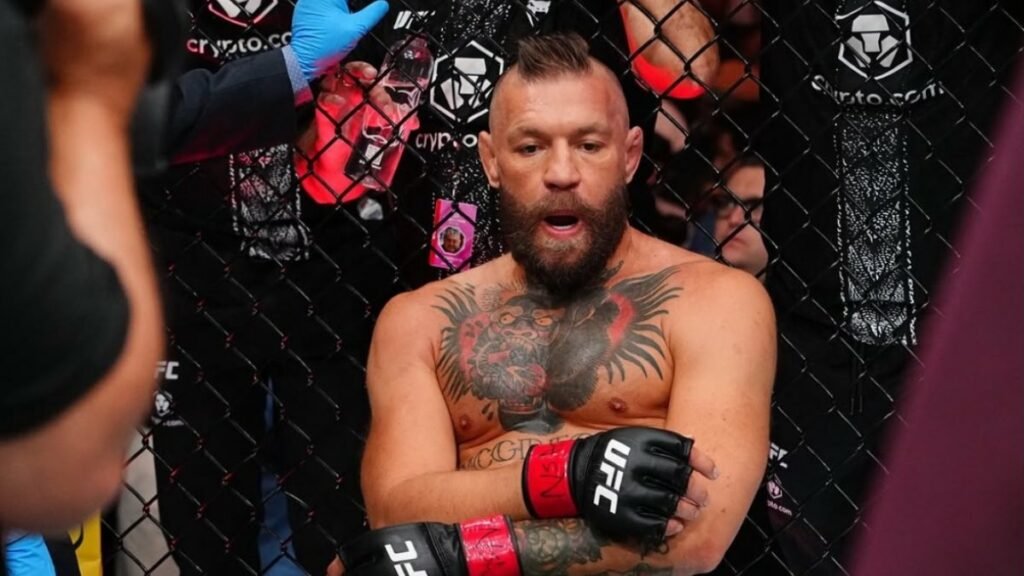
Yet beyond the injury itself, it was McGregor’s own words afterward that revealed the deeper significance of the night. In a heartfelt statement shared following the fight, the former two-division champion exposed a side of himself rarely seen throughout his career. He insisted that he entered the Octagon in peak physical condition, dismissing speculation that he had carried any injury into the contest. According to McGregor, he had been throwing kicks, planting his feet confidently, and performing explosive movements throughout his training camp without experiencing the slightest issue.

He described the injury as something that happened completely out of nowhere, explaining that his joint simply failed without warning. Then came the sentence that captured the emotional devastation of the moment: “I am plunged into darkness… I can only describe it as hell.” It was a remarkable departure from the fearless, provocative persona that has defined the “Notorious” brand for over a decade.
In a message filled with unusual vulnerability, McGregor admitted that he remains in disbelief over what happened. He reiterated that he had never felt better entering a fight and rejected every rumor suggesting otherwise. He even framed the ordeal as a symbolic confrontation with “the devil,” while making it clear that surrender is not part of his mindset. Instead, he spoke of turning to his faith, attending church the following day, and finding the strength to overcome yet another devastating setback.
His response reflects more than simple disappointment—it signals a notable evolution in the way McGregor presents himself to the world. The man who once answered defeat with defiance and relentless psychological warfare is now openly acknowledging pain, uncertainty, and emotional struggle. It suggests that the greatest opponent he faces today may no longer be standing across the cage, but rather the physical limitations of a body that no longer responds with the same reliability that once fueled his rise to superstardom.
From a sporting perspective, the recurrence of serious injuries inevitably raises legitimate concerns about his ability to compete at the elite level again. Years away from competition, accumulated physical damage, and the natural effects of age have combined to make every comeback exponentially more difficult. Determination remains one of McGregor’s defining qualities, but in combat sports, resilience alone cannot always overcome the realities imposed by the human body.
For Max Holloway, meanwhile, the outcome represents one of the most symbolically significant victories of his career—even if fans were denied the competitive battle they had anticipated. Defeating the biggest commercial star in UFC history further strengthens Holloway’s legacy and reinforces his position among the promotion’s modern greats, while McGregor leaves UFC 329 surrounded by more uncertainty than certainty.
Ironically, the main event was not the only fight to end almost instantly. Earlier in the evening, Benoît Saint-Denis was submitted by Paddy Pimblett in less than a minute, turning UFC 329 into a night defined by remarkably brief conclusions. Yet none carried the emotional weight of McGregor’s premature exit—the very athlete around whom the entire event had been built.
The question now extends beyond a single loss. Does Conor McGregor still possess the physical capacity to write another meaningful chapter in his extraordinary career, or are recurring injuries beginning to author the ending that none of his rivals managed to impose inside the Octagon?
For now, the “Notorious” refuses to accept that the story is over. His message remains unequivocal: he will return. But in combat sports, belief alone does not determine destiny. Ultimately, the body always delivers the final verdict. And only time will reveal whether McGregor’s legendary career still holds one final chapter—or whether UFC 329 marked the beginning of its closing pages.