


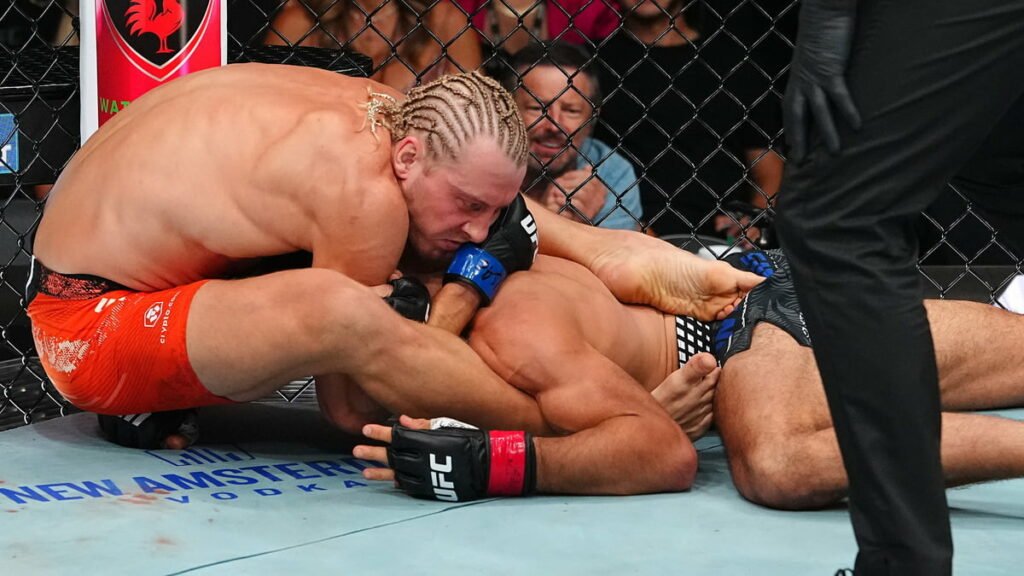
It took Paddy Pimblett just fifty seconds to shatter every prediction and turn the UFC 329 co-main event into one of the year’s most stunning upsets. By putting Benoît Saint Denis to sleep with a perfectly executed choke, the British lightweight delivered a harsh reminder of mixed martial arts’ unforgiving reality: a single tactical mistake can alter the outcome of a fight, reshape a career, and redefine an entire championship race.
Benoît Saint Denis entered the contest riding the momentum of the strongest stretch of his UFC career. Backed by an impressive winning streak, highlighted by a TKO victory over Dan Hooker, the Frenchman had firmly established himself among the elite of the lightweight division. Ranked near the top of the standings, the “God of War” viewed this bout as the final step toward earning a title opportunity. Yet the biggest fights are never decided by rankings or betting odds; they are often determined by one decisive tactical moment capable of overturning every expectation.
Remaining true to his trademark fighting style, Saint Denis immediately imposed an aggressive pace, opening the contest with relentless forward pressure and a high kick designed to seize control from the opening seconds. However, the very aggression that has become his greatest weapon ultimately exposed a vulnerability. Pimblett anticipated the opening with remarkable composure, instantly locking onto his opponent’s neck before transitioning seamlessly into a tight arm-in guillotine choke. In a matter of seconds, the Briton demonstrated that tactical intelligence, technical precision, and flawless execution can neutralize even the most relentless offensive pressure.
Perhaps the most striking image of the contest was not merely the speed of the finish, but the manner in which it unfolded. Saint Denis never tapped. Instead, he chose to fight until he lost consciousness, a moment that reflected both his warrior mentality and the unforgiving nature of mixed martial arts. Courage alone cannot overcome a submission that has been executed to technical perfection.
For Paddy Pimblett, this victory represents far more than another addition to his professional record. It could well become the defining turning point of his UFC career. Defeating—and finishing—a highly ranked contender in such dominant fashion sends a powerful statement throughout the lightweight division. Long viewed primarily as one of the promotion’s biggest personalities and most marketable stars, “The Baddy” has now demonstrated that he possesses the technical skills, tactical maturity, and championship-level composure required to compete with the division’s very best.
For Benoît Saint Denis, however, the defeat carries consequences that extend beyond the loss itself. It not only ends his winning streak but also arrives at the very moment he appeared to be closing in on a title shot. His next challenge will be as much psychological as competitive, as the UFC’s lightweight division remains one of the deepest and most unforgiving weight classes in the sport, where every setback can significantly delay championship ambitions.
Beyond the result itself, UFC 329 delivered a broader message about the state of the lightweight division. The race toward the championship has become more unpredictable and fiercely contested than ever before. In less than a minute, Paddy Pimblett did more than win a fight—he reshaped the competitive landscape of an entire division. It was a performance that reaffirmed one of MMA’s enduring truths: championships are not awarded on reputation or expectations, but to those who seize the decisive moment when the opportunity presents itself.