


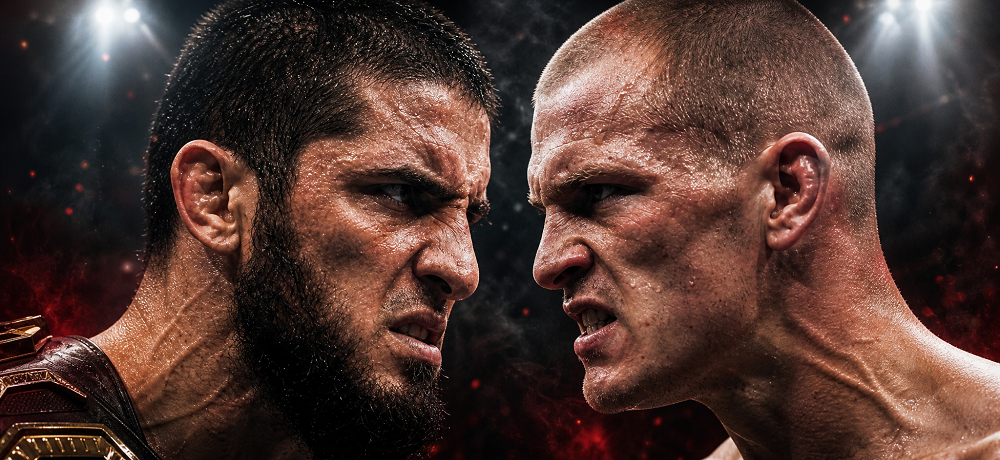
The real question ahead of UFC 330 is not who will win between Islam Makhachev and Ian Machado Garry.
The real question is whether Islam Makhachev has reached the point where his name has become larger than the names of the men standing across from him—or whether the UFC is about to test, for the first time, the true limits of a reign that has appeared almost untouchable.
With less than two months remaining before Philadelphia hosts one of the biggest events of the year, this matchup has grown into something far greater than a routine title defense. After dominating the lightweight division for years before successfully capturing the welterweight championship, Makhachev is no longer fighting simply to keep a belt around his waist.
He is fighting to build an era.
Every victory now moves him further away from championship status and closer to historical significance.
That is precisely why Jon Jones’ recent comments carry far more weight than a simple prediction.
When one of the greatest fighters in MMA history declares that Makhachev is the favorite because of his extraordinary wrestling pedigree, he is doing more than offering an opinion. He is revealing how the sport’s elite currently view the Dagestani champion.
“Beating wrestlers at this level is incredibly difficult,” Jones explained before going even further, describing Makhachev as “possibly the best fighter on the planet,” suggesting that only two names truly belong at the summit of mixed martial arts today—his own and Islam Makhachev’s.
Yet MMA history repeatedly teaches the same lesson.
Consensus is often the most dangerous place for a champion to stand.
The sport has consistently reminded its fans that dominance is temporary, reputations guarantee nothing once the Octagon door closes, and every champion—regardless of how unbeatable they appear—eventually faces a night when expectations become heavier than the championship belt itself.
That reality makes Ian Machado Garry a far more intriguing challenger than many initially assumed.
The UFC has not selected another opponent built primarily around physical strength or aggressive pressure. Instead, it has matched Makhachev with one of the most modern representatives of the new generation of mixed martial artists.
Tall.
Mobile.
Highly intelligent in managing distance.
Technically disciplined.
Most importantly, Garry possesses one quality that immediately captures the attention of experienced analysts: elite takedown defense.
That single detail may ultimately define the entire fight.
Throughout his UFC career, Islam Makhachev has built one of the most efficient systems in modern MMA. His wrestling is not simply a weapon; it is the foundation upon which every aspect of his offense is constructed. Cage control, positional dominance, relentless pressure and suffocating grappling gradually dismantle opponents both physically and mentally.
Against Garry, however, the central question is not whether the Irish contender can outstrike the champion.
The more significant question is whether he can prevent Makhachev from ever implementing the game that has made him nearly unstoppable.
If Garry succeeds in forcing long striking exchanges while consistently denying takedowns, Makhachev may find himself spending extended periods in tactical territory that few opponents have been able to impose upon him during recent years.
If, on the other hand, the Dagestani quickly establishes control through wrestling and top pressure, the contest could become yet another demonstration of why the Dagestani system continues to define championship excellence across the sport.
Yet the significance of this matchup extends well beyond technical analysis.
Ian Machado Garry is not approaching this fight with the mentality of a grateful challenger hoping to compete respectably against a dominant champion.
His public statements reveal a much larger ambition.
He wants to become the man who ends one of the defining reigns of modern MMA.
When Garry speaks about changing history, he is not merely engaging in promotional theatrics. He is attempting to separate himself psychologically from the long list of contenders who entered championship fights already burdened by the belief that defeating Makhachev was almost impossible.
Meanwhile, Islam Makhachev fully understands that competing at welterweight changes the nature of every challenge he now faces.
The athletes are naturally bigger.
The reach advantages are greater.
The physical strength is more evenly distributed.
Managing distance becomes increasingly complex, and many of the athletic advantages he enjoyed at lightweight become significantly smaller.
For that reason, this first welterweight title defense is not merely an examination of whether he remains the better fighter.
It is an examination of whether his entire competitive system can successfully adapt to a different physical landscape.
The stakes extend beyond both athletes.
For the UFC itself, this fight represents an investment in the future of the organization.
A dominant victory by Makhachev further strengthens the image of a champion capable of joining the greatest fighters the sport has ever produced while opening the door to even more historic achievements.
A shocking victory by Garry would instantly create a new global star capable of leading one of the UFC’s premier divisions for years to come.
In an industry where commercial success depends upon the constant renewal of elite stars without diminishing established legends, both outcomes serve the organization’s long-term interests.
That explains why opinions remain divided despite Makhachev entering as the clear favorite.
Oddsmakers, former champions and many respected analysts logically favor the reigning champion.
Yet another significant segment of the MMA community believes Garry possesses exactly the technical profile capable of creating problems unlike any Makhachev has faced in recent years.
His height.
His reach.
His movement.
His composure under pressure.
Most importantly, his ability to defend takedowns.
Together, these attributes may transform UFC 330 into the most tactically demanding fight of Makhachev’s championship career.
Ironically, Jon Jones’ endorsement also places an enormous burden upon the champion.
Being publicly recognized by one of the greatest fighters in history as the best athlete in the world changes the standards by which every performance will be judged.
From that moment forward, victories become expectations rather than achievements.
Defeat, however, instantly becomes history.
That is why Islam Makhachev versus Ian Machado Garry is about far more than defending a world title.
It is a confrontation between two generations.
Two philosophies of fighting.
Two competing visions of how dominance is achieved inside modern mixed martial arts.
On one side stands the Dagestani model—built upon wrestling, discipline, relentless control and strategic patience.
On the other stands a new generation of complete mixed martial artists who believe mobility, versatility and tactical evolution can finally challenge the formula that has dominated the sport for over a decade.
The final answer will not come from Jon Jones.
It will not come from analysts.
Nor will it come from betting markets.
It will emerge only after the Octagon door closes in Philadelphia.
Because mixed martial arts has always recognized one truth above all others:
History never protects great champions.
It simply demands that they prove, every single time they compete, that they still deserve their place within it.