


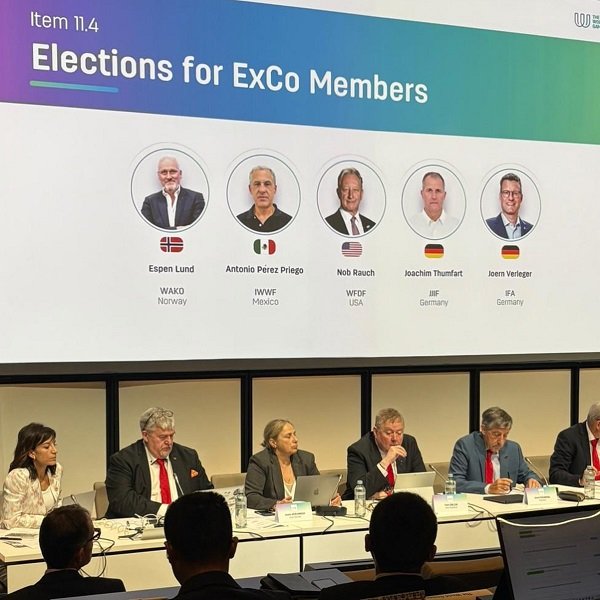
At first glance, it appears to be a technical development, but in reality it reflects a deeper restructuring of global kickboxing power dynamics. The election of Espen Lund to the Executive Committee of the International World Games Association (2026–2030 term) coincides with a transitional phase within the Moroccan Royal Federation of Kickboxing. This overlap is not accidental; it highlights a strategic reshaping of influence in a rapidly evolving combat sport landscape.
Lund, Vice-President of the World Association of Kickboxing Organizations and President of WAKO Europe, secured 33 out of 39 votes, a result that signals not only personal legitimacy but also the consolidation of European influence within global governing structures. Within the ecosystem linked to the International Olympic Committee, the IWGA plays a crucial role through The World Games, which function as a gateway toward potential Olympic recognition.
In this context, a stark reality emerges:
Morocco is outside decision-making circles = outside influence over the future of the sport.
Although Morocco remains an official member of WAKO, its presence is largely symbolic due to the absence of representation in key international executive bodies. This transforms participation into passive engagement in a system where real power is increasingly concentrated within institutional networks rather than sporting arenas.
At the same time, the Moroccan federation’s electoral congress unfolds as an internal restructuring process. Yet the fundamental question is not about leadership changes, but about strategic direction: is this merely administrative reshuffling, or a genuine attempt to integrate into global governance structures?
The analysis shows that the issue is no longer purely athletic. It has become structural and geopolitical within sport governance. Nations that influence kickboxing today are those occupying decision-making positions within WAKO and IWGA, not necessarily those producing the strongest athletes.
As the The World Games approach in 2029 in Karlsruhe, the gap widens between countries shaping the future and those merely observing it. Morocco, despite its significant talent pool, remains caught between sporting performance and institutional absence.
Ultimately, the real contest is no longer inside the ring—it is within the governing structures that define who gets to shape the future of the sport itself.