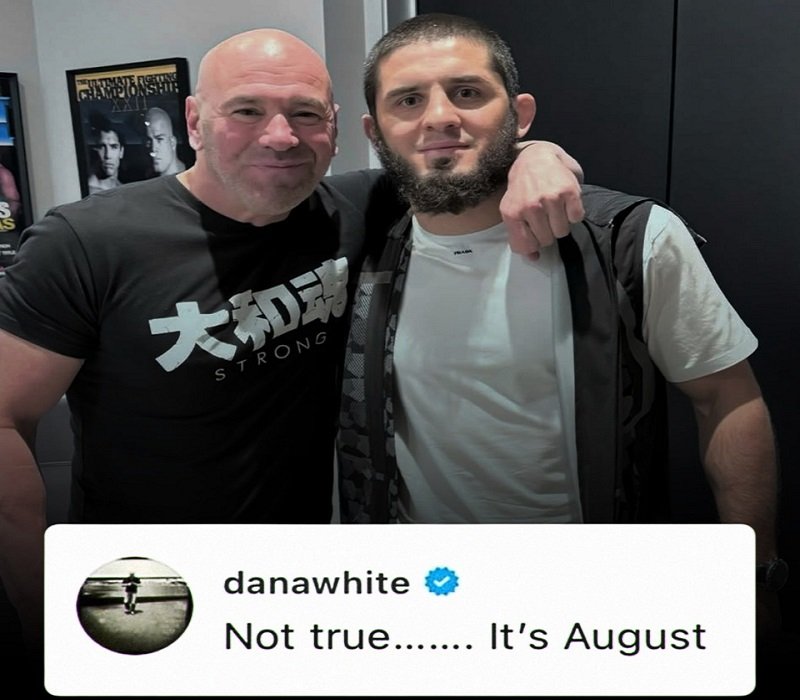
Amid growing uncertainty surrounding the return of UFC lightweight champion Islam Makhachev, the intervention of Dana White has brought more than just clarity—it has subtly reshaped the strategic landscape of an already volatile division. By confirming August as the timeline for Makhachev’s comeback, the UFC president did not merely dismiss speculation; he reasserted control over the narrative, where timing becomes a calculated instrument of both sporting and promotional power.
Earlier projections, fueled by statements from his manager Ali Abdelaziz, pointed toward a potential return during the summer, possibly aligned with the International Fight Week—one of the UFC’s most commercially significant events. Yet, White’s firm rebuttal suggests a different reading: a carefully managed schedule influenced not only by medical considerations—particularly a hand injury that has sidelined the champion—but also by broader strategic planning regarding his career trajectory.
Beyond timing, a deeper question emerges: is Makhachev on the verge of transitioning to the welterweight division? Such a move would not simply be a change in weight class, but a transformation in competitive identity, requiring adaptation to a different spectrum of physicality, pace, and tactical diversity.
In the absence of an officially confirmed opponent, multiple scenarios remain open, each reflecting distinct strategic directions. Ian Machado Garry represents the rising contender, actively positioning himself for a breakthrough opportunity. Michael Morales embodies long-term investment, a prospect the UFC could elevate to build future narratives. Meanwhile, Kamaru Usman stands as a high-value option, combining elite experience with strong market appeal.
Conversely, the potential superfight against Ilia Topuria appears, at least for now, to be on hold, largely due to Topuria’s expected clash with Justin Gaethje in a title unification context. This situation highlights the intricate balancing act within the UFC, where matchmaking decisions are shaped not solely by meritocracy, but by timing, market dynamics, and long-term storytelling.
Ultimately, Dana White’s announcement transcends a simple scheduling update—it functions as a strategic recalibration of the competitive ecosystem. The key question now is whether Makhachev’s August return will reinforce his established dominance, or signal the beginning of a transformative chapter aimed at redefining his legacy within the sport.