A power struggle that goes far beyond fighting
Francis Ngannou’s recent comments about a potential fight with Jon Jones were anything but accidental. They came at a precise moment, in a rapidly evolving MMA landscape where fighter autonomy is beginning to challenge long-established power structures.
Dana White’s response, however, was immediate and uncompromising. No negotiations. No ambiguity. Just closure.
Ngannou: sporting ambition or calculated leverage?
By stating that his PFL contract will expire before the highly publicized “White House card,” and that he would welcome a fight with Jon Jones if the opportunity arises, Ngannou speaks as a man fully aware of his market value.
This is not merely a fighter expressing a dream.
It is a strategic message.
A Ngannou–Jones matchup is not just another bout — it is a global event, capable of reshaping narratives and revenue streams alike.
The real question, therefore, is not can he return?
But what would his return represent for the UFC’s authority?
Dana White’s “zero”: more than a number
White’s reply leaves no room for interpretation:
“My interest in signing Francis Ngannou is zero. The happiest moment of my life was when I let him go to the PFL.”
In an industry where business often overrides emotion, this statement stands out. White is not discussing finances or logistics. He is drawing a line in the sand.
“Zero” here is not a figure. It is a stance.
The backstage incident: where trust collapsed
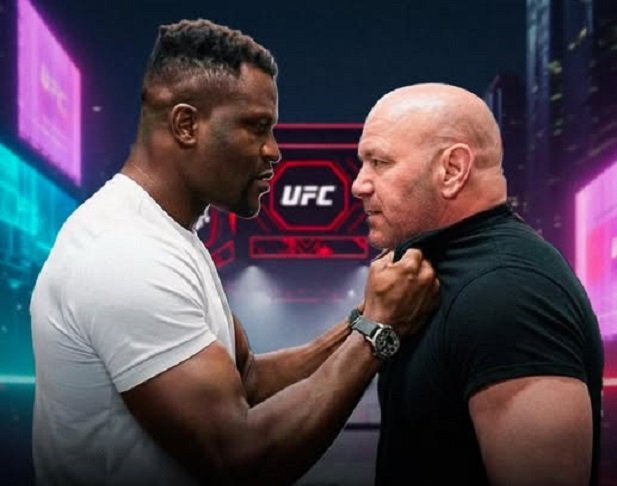
Dana White revisited the backstage confrontation that reportedly occurred at UFC headquarters. According to him, it was not a threat or violent altercation, but a tense exchange rooted in financial disagreement.
Yet one detail remains central in his narrative:
the gesture. The hand on the chest. The refusal to end the conversation.
In positions of power, such moments carry symbolic weight.
For White, that was the breaking point — the moment he decided he could no longer trust Ngannou.
From ideal champion to “someone I don’t want to do business with”
White openly admits that he once believed Ngannou embodied everything a heavyweight champion should be. That contrast makes the current rupture even more telling.
Was Ngannou rejected because of who he is — or because of what he challenged?
Francis Ngannou hints at a return… Dana White shuts the door completely 🔥
🗣️ Ngannou: “My PFL contract ends before the White House card, and if the opportunity comes, I want Jon Jones.”
🗣️ White: “My interest is zero. One of my happiest moments was seeing him go to the PFL.” pic.twitter.com/M98nSFsO5O
— mmamag.ma (@jamalsoussi10) December 13, 2025
His departure from the UFC was not just a career move. It was a statement. A champion walking away from a system he deemed restrictive, and succeeding elsewhere.
Beyond personal conflict: a structural debate
Today, Dana White appears content with the separation. Ngannou has moved on.
But the broader implications remain:
-
Who truly holds power in modern MMA?
-
How much independence can a fighter claim before facing institutional resistance?
-
And can the UFC’s model adapt to a new generation of athletes demanding more control?
Final thought: a closed door, unanswered questions
Dana White insists the chapter is closed.
History suggests otherwise.
Whether Ngannou ever returns to the UFC is almost secondary. What matters is what he has already forced the sport to confront:
Is a fighter merely a contracted asset — or an equal stakeholder in the business of combat?
That question, unlike the door Dana White claims to have shut, remains wide open.