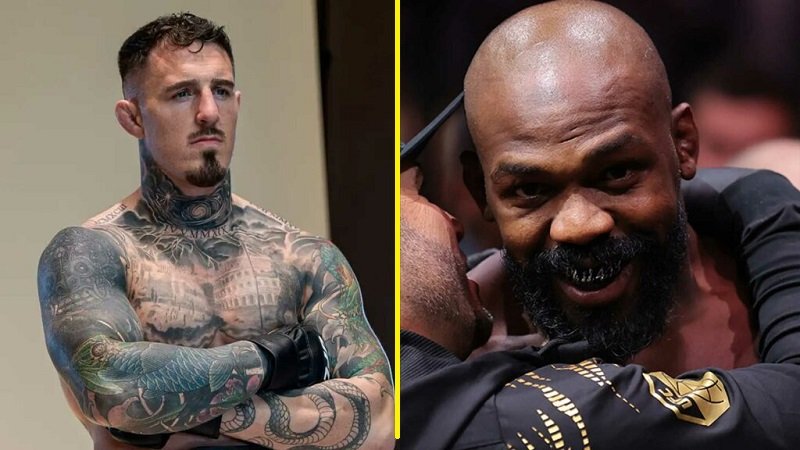
Although the fight itself has yet to materialize, a potential clash between Jon Jones and Tom Aspinall remains a recurring topic within the MMA landscape. More than a fantasy matchup, it has become a symbolic reference point for the current transition within the UFC heavyweight division, where legacy, legitimacy, and generational shift intersect. In that context, Dominick Cruz’s recent comments offer a perspective that goes beyond surface-level speculation.
Speaking on his Love & War podcast, the former bantamweight champion anchored his analysis in specific technical observations drawn from Aspinall’s bout against Ciryl Gane at UFC 321. Despite the fight ending prematurely due to an eye poke, Cruz believes the brief exchanges provided enough evidence to question long-held assumptions about Aspinall’s wrestling effectiveness—particularly when measured against a fighter of Jon Jones’ caliber.
Cruz’s assessment does not read as an outright dismissal of the reigning champion, but rather as a recalibration of the narrative surrounding him. He suggests that Aspinall’s previous success may have been amplified by the stylistic profiles of his opponents, many of whom lacked elite grappling credentials. Gane’s improved defensive wrestling, in Cruz’s view, subtly exposed the possibility that Aspinall’s ground game may not be as dominant as previously believed.
Conversely, Jon Jones is portrayed as operating on a fundamentally different structural level. Cruz highlights a combination of attributes rarely found in a single heavyweight: high-level collegiate wrestling, elite fight IQ, masterful distance management, and the ability to control opponents in the clinch through underhooks and Greco-Roman techniques. Taken together, these tools could significantly limit Aspinall’s offensive freedom, regardless of age or physical advantages.
Notably, Cruz also pushed back against criticism directed at Aspinall following the eye poke incident, rejecting claims that the stoppage reflected a lack of toughness. By referencing ongoing medical concerns and rumors of eye surgery, he reframed the situation as a legitimate health issue rather than a competitive excuse, urging a more measured interpretation of the event.
Beyond individual opinions, the broader picture remains unresolved. Aspinall is a champion in recovery, with no confirmed return date, while Jon Jones—after a brief retirement—continues to hint at a comeback, all while serving as a coach on a Russian edition of The Ultimate Fighter opposite Daniel Cormier. The UFC, meanwhile, finds itself balancing the promotion of its present champion with the enduring commercial and symbolic pull of one of its most iconic figures.
In that sense, Cruz’s commentary functions less as a definitive prediction than as a strategic lens. It underscores a recurring truth in the heavyweight division: titles confer status, but legitimacy is ultimately forged through stylistic trials and generational confrontations—tests that, for now, remain pending inside the Octagon.