Before the bell rings, before fists are raised, the scale delivers its first verdict.
And in boxing, the scale is never just a formality — it is a storyteller.
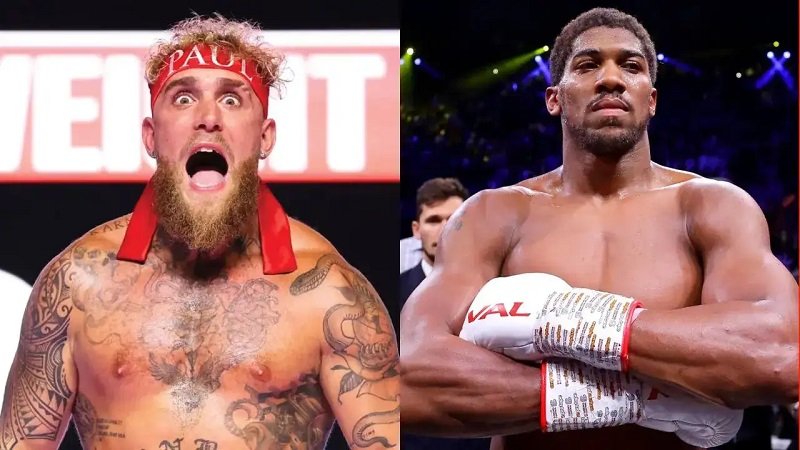
Anthony Joshua stepping in at 110.4 kg, against Jake Paul’s 98.2 kg, is not merely a 12-kilogram difference. It is a symbolic gap. One that separates two philosophies, two timelines, and two ideas of what boxing is — and what it might become.
🚨 Anthony Joshua and Jake Paul both make weight! 🥊
⚖️ Jake Paul: 216.6 lbs (98.2 kg)
⚖️ Anthony Joshua: 243.4 lbs (110.4 kg)
➡️ A 12 kg difference between them… we’ll get the answer tomorrow! 😳🧷 #MostVpromotions pic.twitter.com/Sx0R3bapbX
— mmamag.ma (@jamalsoussi10) December 18, 2025
Weight as a silent statement
In the heavyweight division, weight is a language.
Joshua’s size is not just physical dominance; it is the extension of a legacy shaped by world titles, structured progression, public collapse, and disciplined rebuilding. His body carries the memory of traditional boxing — earned, regulated, hierarchical.
Jake Paul arrives lighter, but armed with a different kind of power.
He is a product of the digital age, where visibility often comes before validation, and where narratives can be built faster than résumés.
The fight before the fight
The weigh-in becomes a psychological battlefield.
Joshua’s mass sends a clear message: “I am the system. You are the disruption.”
Paul, meanwhile, must defend a modern argument — that boxing today is not governed by size alone, but by adaptability, timing, and control of the moment.
The underlying question is unavoidable:
can a fighter shaped by accelerated fame survive against an institution embodied by a former two-time heavyweight world champion?
A context that matters
This bout was never meant to happen.
Jake Paul was originally scheduled to face Gervonta “Tank” Davis, a fight carefully designed within safer boundaries. Legal issues removed Davis from the equation — and Anthony Joshua stepped in, raising the stakes dramatically.
This was not a simple replacement.
It was a shift from spectacle to genuine danger.
Two paths, one ring
Joshua represents the classical blueprint: Olympic gold, championship belts, devastating defeats, and an ongoing search for redemption.
Paul, by contrast, has navigated boxing since 2020 outside its traditional ecosystem, selecting opponents and weights that allowed momentum without full exposure.
His climb to 103 kg against Mike Tyson produced little substance. At 98 kg against Joshua, there will be no hiding place.
What is truly at stake
For Joshua, defeat would mean more than a loss — it would challenge the idea that heavyweight boxing still belongs to its rightful heirs.
For Paul, victory would be a cultural shockwave, forcing the sport to reconsider how legitimacy is defined.
Final thought
The scale has spoken.
The ring will decide.
This fight is not merely about who hits harder, but about which vision of boxing survives the night.
The weight advantage clearly favors Anthony Joshua.
Yet the real question lingers:
who is truly carrying the future of boxing on his shoulders?