When a Championship Searches for Meaning Beyond Its Weight Class
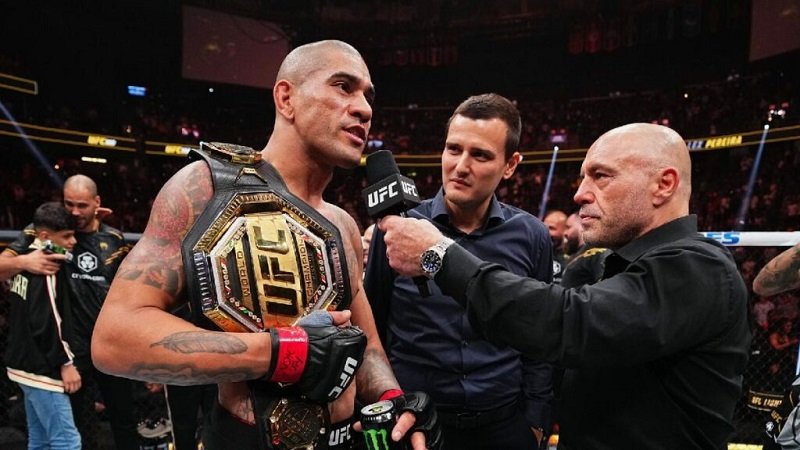
The significance of a statement lies not in its shock value, but in what it exposes about the logic governing the backstage. Joe Rogan’s suggestion of a potential heavyweight clash between Alex Pereira and Ciryl Gane is not merely an intriguing rumor; it is a window into a deeper uncertainty surrounding the UFC’s most prestigious division.
On the surface, the idea is compelling. A fearsome striker, newly restored as light heavyweight champion, aiming even higher. The narrative of the multi-division conqueror has always been a powerful commercial and symbolic tool in modern MMA. Yet serious analysis cannot stop at the allure of history. It must ask why now—and under what conditions.
The answer lies in the fragile state of the heavyweight division itself. Tom Aspinall’s eye injury, the absence of a clear timeline for his return, and the organization’s reluctance to either freeze or fully restructure the division have created a vacuum. In such moments, spectacle often becomes a substitute for long-term sporting clarity.
Within this context, Alex Pereira is no longer just an ambitious fighter. He becomes a temporary stabilizer in an unstable system. What is framed as a “super fight” begins to resemble an institutional workaround—an attempt to keep the division alive through crossover appeal rather than internal coherence.
Joe Rogan’s carefully hedged comments reinforce this reading. Whether or not the bout materializes is almost secondary. The fact that it is being seriously discussed speaks volumes about the current decision-making philosophy. A flagship division should be built on competitive continuity, not on opportunistic matchmaking.
Ciryl Gane’s role in this scenario is equally revealing. Seeking to reassert his position after a turbulent run, he needs a fight that clarifies his standing. Yet facing a former champion from a lower weight class, however dangerous, raises a sensitive issue: is this a genuine competitive test, or a matchup engineered primarily for narrative impact?
UFC history shows that weight-class jumps are rarely neutral experiments. Some have created legends; others have exposed the physical and strategic limits of the concept. The difference has always been rooted in intent—organic sporting evolution versus emergency response to structural uncertainty.
Viewed through this lens, the Pereira-at-heavyweight fantasy loses much of its romanticism. Knockout power alone does not establish lasting legitimacy in a division defined by durability, mass management, and sustained performance. When titles drift away from clear competitive logic, they risk becoming theatrical props rather than sporting milestones.
The UFC is not obliged to suppress ambition—but it is responsible for organizing it. And journalism, if it is to fulfill its role, must look beyond immediate excitement and insist on a basic truth: the greatest fights emerge from coherent systems, not from voids filled in haste.
Whether this fight happens or not is almost beside the point.
The real question is not who fights whom, but what vision currently guides the heavyweight championship itself.