


Ciryl Gane’s victory over Alex Pereira at UFC Freedom 250 inside the White House was far more than another win added to his professional record. It felt like a defining moment in the evolution of the French heavyweight, perhaps even the beginning of a new chapter in his career. For years, Gane has been viewed as one of the most naturally gifted heavyweights in mixed martial arts, a fighter blessed with extraordinary movement, technical sophistication, and tactical intelligence. Yet one question continued to follow him throughout his rise: could he transform immense potential into lasting greatness when the stakes were at their highest?
Against Alex Pereira, that question began to receive an answer.
Pereira is not simply a former champion or a dangerous striker. He is one of the most feared finishers in modern combat sports, a fighter capable of changing the course of a contest with a single punch. Under those circumstances, Gane’s challenge was never merely about winning. It was about dismantling the conditions that make Pereira so lethal in the first place.
From the opening moments, the Frenchman refused to engage on his opponent’s terms. Rather than entering a straightforward striking battle, he turned the fight into a contest of intelligence and adaptation. His objective was not to beat Pereira at his own game but to force him into a state of constant uncertainty.
When Gane explained afterward that he could not allow Pereira to control the center of the cage, he revealed the strategic foundation of the entire fight. Great champions are rarely defeated solely by superior force. More often, they are beaten when they are denied the environment that allows their strengths to flourish. Pereira’s power becomes most dangerous when he dictates the pace, the distance, and the geography of the fight. Gane systematically dismantled that framework.
His takedown attempts perfectly illustrated this philosophy. They were not merely attempts to bring the fight to the ground. They were tools designed to create doubt. Every wrestling threat forced Pereira to think, to adjust, and to divide his attention between multiple dangers. In modern MMA, psychological warfare often begins long before punches land.
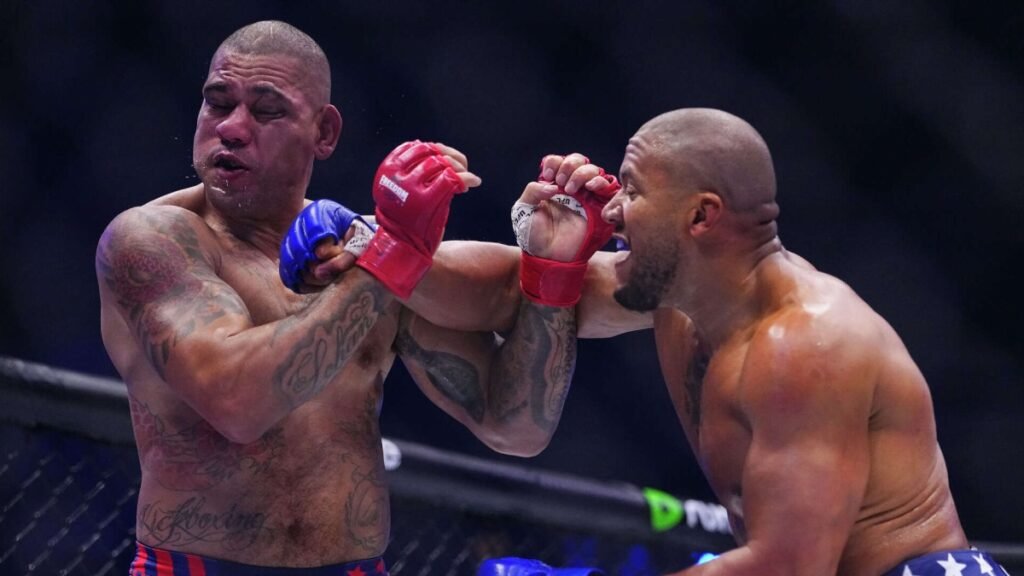
Every feint, every level change, and every tactical adjustment became another piece of information Pereira had to process. At the elite level, fights are frequently decided by cognitive overload. The more scenarios a fighter must evaluate simultaneously, the greater the likelihood of a mistake. Viewed through that lens, the decisive jab was not a fortunate moment. It was the natural outcome of a carefully constructed strategic process.
The victory also highlights another dimension of Gane’s evolution: mental preparation. By revealing that he had visualized the finishing jab before the fight, the Frenchman offered insight into one of the most important yet often overlooked aspects of elite performance. Today’s champions do not train only their bodies. They train their minds to recognize opportunities before those opportunities appear.
Visualization has become a central tool in high-performance sport. It allows athletes to experience success mentally long before it occurs in reality. When the decisive moment finally arrives, the brain is not encountering a new situation. It is executing a scenario that has already been rehearsed countless times.
For Ciryl Gane, this psychological growth may be the most significant development of all. Throughout his career, critics occasionally questioned his killer instinct or his ability to impose himself during pivotal moments. Yet his performance against Pereira suggested something different. It revealed a fighter who no longer seems concerned with proving his worth and instead competes with the confidence of someone who fully understands his capabilities.
Beyond Gane’s personal journey, the victory carries broader significance for French MMA. Since the sport’s legalization in France, the country has produced an impressive generation of athletes. Yet sustained dominance in the heavyweight division remains one of the most difficult achievements in combat sports. Heavyweight champions occupy a unique place in the public imagination, often symbolizing the ultimate measure of fighting excellence.
History, however, teaches a recurring lesson: reaching the summit is often easier than remaining there. Victory creates expectations. Expectations create pressure. Pressure creates new challenges.
At the White House, Ciryl Gane proved that intelligence, discipline, preparation, and tactical sophistication can overcome one of the most feared strikers of his era. Yet the most important question remains unanswered. Was this performance the peak of a remarkable night, or was it the opening chapter of a new era in the career of a fighter who may finally have discovered the best version of himself?
The answer to that question, more than the result itself, will ultimately determine the true historical significance of this victory.