


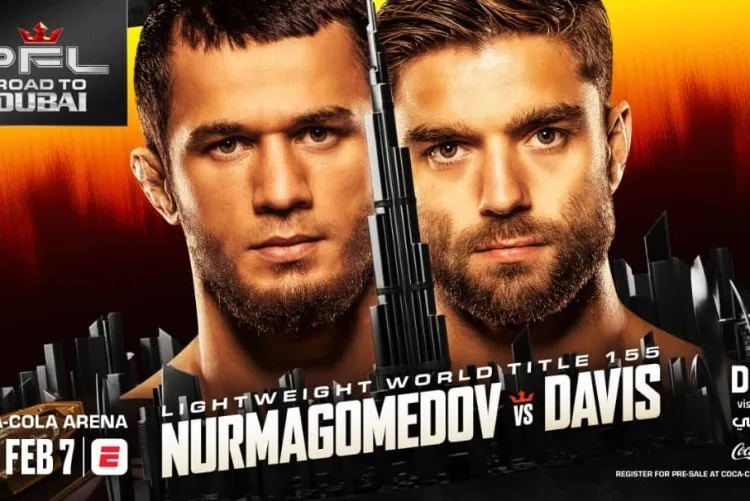
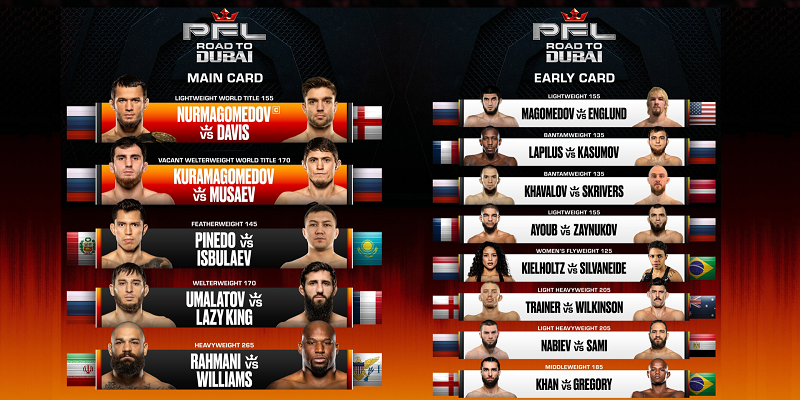
At first glance, the fight card unveiled by the Professional Fighters League for its February 7 event in Dubai appears to reflect what the organization does best: strong names, clearly defined stakes, and a sporting aesthetic calibrated for an international audience. Yet beyond the alignment of matchups, this evening reveals something deeper—about PFL’s current trajectory, its approach to building champions, and the subtle balance between sport, strategy, and geopolitics in modern MMA.
Usman Nurmagomedov: The Central Figure of a Declared Model
By placing Usman Nurmagomedov at the top of the card, PFL is doing more than defending a lightweight belt. It is defending a narrative. Undefeated (20–0), heir to a name that has become a global combat brand, Usman embodies a form of continuity: a disciplined, methodical, almost clinical style of MMA rooted in the Caucasian school.
His matchup against Alfie Davis, winner of the 2025 tournament, brings two logics face to face. On one side stands an established champion, protected by a carefully managed trajectory and an already international status. On the other, a pure product of the PFL system, forged through the tournament format, symbolizing the meritocratic promise the league has claimed since its inception. This fight is not merely a main event; it is a credibility test for PFL’s sporting model against the logic of star-making.
Two Undefeated Fighters, One Belt: Risk as Spectacle
The co-main event pushes this logic even further. Ramazan Kuramagomedov versus Shamil Musaev features two undefeated fighters, a vacant belt, and one certainty: one of them will leave Dubai without his perfect record. This is no trivial choice. It reflects a deliberate desire to generate real risk, not just controlled entertainment.
In an MMA landscape where careers are often excessively protected, PFL continues to walk this delicate line—offering high sporting value fights, even at the cost of breaking flawless trajectories. It is a bold approach, and one that also reveals a league still searching for its identity among the sport’s giants.
The French Fighters: Between Confirmation, Repair, and Expectation
The presence of three French fighters adds another layer of interpretation, more political in the sporting sense. Amine Ayoub, Taylor Lapilus, and Abdoul Abdouraguimov are not coming to Dubai for symbolism. Each carries a different stake.
Lapilus, undefeated in PFL competition, perhaps best represents quiet consistency, far from excessive spotlight. Abdouraguimov returns after a highly discussed withdrawal in Nantes; his bout against Magomed Umalatov feels like an attempt at rebalancing—reasserting his place through performance rather than discourse. As for Ayoub, his position on the preliminary card serves as a reminder of a rarely acknowledged reality: European MMA, however technically refined, remains in a constant phase of validation on the international stage.
Dubai: A New Symbolic Crossroads
The choice of Dubai is not neutral. The city is increasingly establishing itself as a hub of globalized sport, where capital, athletes, and geopolitical ambitions intersect. For PFL, launching its year there affirms an expansion strategy beyond the traditional America–Europe axis. It also sends a message to fighters: the center of gravity of MMA is no longer fixed.
One Card, Multiple Readings
Ultimately, the PFL Dubai card cannot be reduced to a succession of fights. It exposes a vision—that of an organization attempting to reconcile pure sport, controlled storytelling, and territorial expansion. One question remains, seemingly simple yet heavy with meaning: will Usman Nurmagomedov retain his belt?
The answer will certainly say something about the fight. But above all, it will reveal where PFL stands in its pursuit of global legitimacy.