


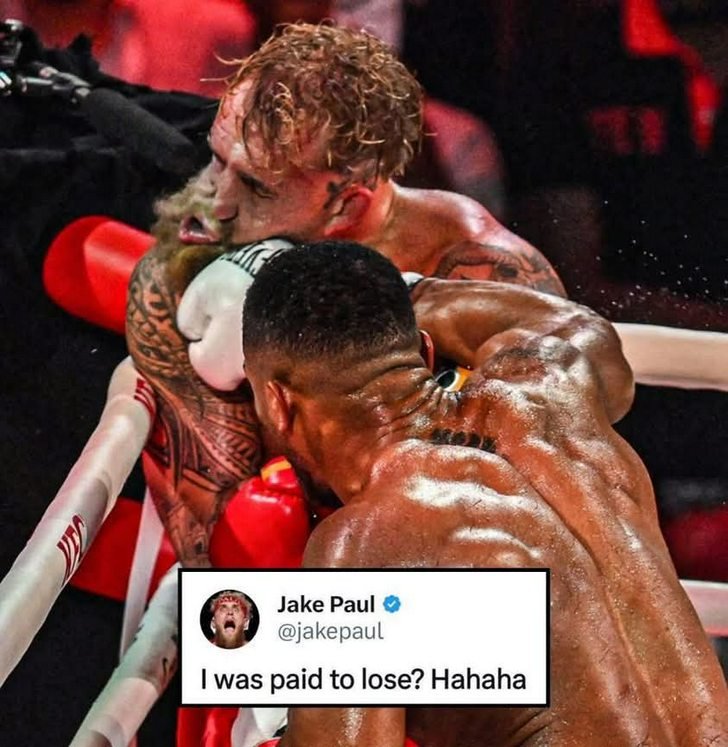
On that uneasy night suspended between spectacle and examination, between manufactured hype and raw reality, Jake Paul vs. Anthony Joshua was never just another boxing match.
It was a public stress test — not of fists alone, but of an idea that increasingly haunts modern boxing:
how far can noise travel before it collides with history?
Jake Paul entered the ring carrying more than gloves.
He carried a narrative. A carefully constructed arc: the YouTuber who refused his assigned role, the crossover fighter powered by algorithms, platforms, and a streaming giant’s global reach. Across from him stood Anthony Joshua — not merely a former champion, but a living archive of the heavyweight division, shaped by belts, losses, recoveries, and time.
Eight rounds were scheduled.
Only six truly happened.
The gap between those numbers is not technical. It is symbolic.
💥 ANTHONY JOSHUA KNOCKS OUT JAKE PAUL IN ROUND 6!
💥 أنتوني جوشوا يُسقط جيك بول بالضربة القاضية في الجولة السادسة!
💥 ANTHONY JOSHUA MET JAKE PAUL KO AU 6ᵉ ROUND !#Boxing pic.twitter.com/7gg84gMKPX
— mmamag.ma (@jamalsoussi10) December 20, 2025
The knockout in the sixth round was neither shocking nor scandalous. It aligned neatly with betting odds, expert forecasts, and the unspoken logic of the sport. What it did, above all, was restore a hierarchy momentarily blurred by promotion and packaging.
Yet the most revealing moments came after the final bell.
Jake Paul did not retreat.
He did not hide behind excuses, nor did he inflate his suffering. He spoke calmly — almost disarmingly so. He mentioned a broken jaw without theatrics, as if noting a medical detail rather than claiming a badge of honor. Then came the sentence that quietly reframed everything:
“A great little beating by one of the greatest of all time.”
In that instant, the posture shifted.
Paul was no longer posturing as a disruptor challenging the institution, but as an outsider acknowledging its weight.
🚨 Jake Paul partage la radio de sa mâchoire et affirme souffrir d’une “double fracture” ! 😳 🗣️ « Donnez-moi Canelo dans 10 jours. » 🙄
🧷 Instagram / jakepaul #Boxing pic.twitter.com/yh9GIICfrG— mmamag.ma (@jamalsoussi10) December 20, 2025
When Ariel Helwani asked whether he was surprised to last six rounds against a former two-time unified heavyweight champion, Paul’s answer revealed more than it explained. He wasn’t surprised. He was tired.
Tired, he said, from carrying Joshua’s weight.
Here, “weight” stops being a number on a scale. It becomes a metaphor for the division itself — a category built on density, punishment, and accumulated craft. Heavyweight boxing, Paul seemed to admit, is not a place for shortcuts.
Still, he left the ring satisfied.
Not because defeat is beautiful, but because it fit into a longer arc he now appears willing to accept. An arc that bends away from heavyweight spectacle and toward cruiserweight pragmatism, where physical disparities narrow and experience can speak louder than mythology.
Between the lines, a recalibration is taking place.
Jake Paul is no longer trying to leap over chapters. He is editing the story. Moving from the fantasy of instant legitimacy to the slower logic of construction.
The loss to Joshua does not collapse the project.
It strips it of illusion.
And paradoxically, that may make what comes next more serious — and more dangerous — than what preceded it.
The real question, then, is not:
Did Jake Paul fail?
But rather:
Did he finally understand where boxing actually begins?
In this sport, not every loss is a fall.
Some are thresholds.
Moments where the noise fades, and something quieter — and far more credible — takes shape.