


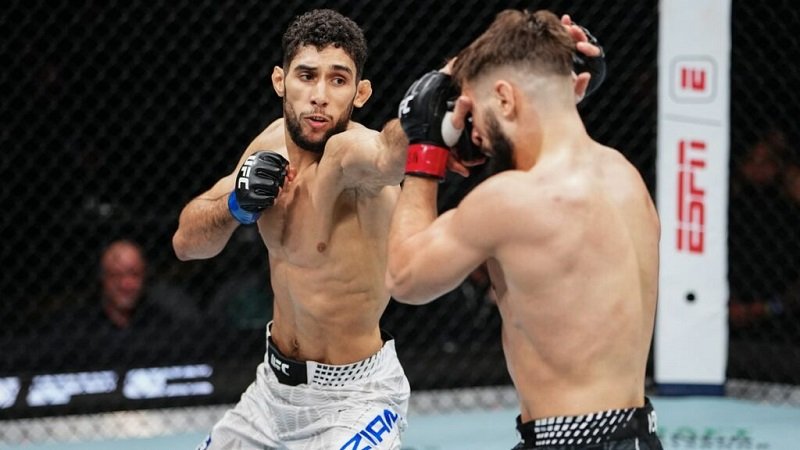
In Las Vegas, the city where legends are built and broken in the same night, Farès Ziam’s clash with Nazim Sadykhov at UFC 323 was never just another fight on the card. What unfolded inside the Octagon felt like a turning point — a moment suspended between promise and confirmation, between “solid fighter” and true contender.
Ziam didn’t step into the cage to win a decision. He walked in as though a chapter of his career had to be written in capital letters… or never be written at all.
Round 1: Setting the tone before the storm
From the opening exchanges, one thing was evident: Ziam arrived with a plan. In the clinch — where strength collides with willpower — the Frenchman of Algerian descent imposed his physical and tactical presence. Level changes, pressure against the fence, a clean takedown.
On the ground, he took the back, locked in a body triangle and looked for the choke. Sadykhov resisted, but the fight was already tilting — mentally, territorially, strategically.
That first round was a warning. This was Ziam’s world now. His pace. His space. His rules.
Round 2: When silence hits harder than noise
In great fights, the mind often breaks before the body. As the second round began, the shift was no longer technical — it was psychological. Ziam grew calmer, sharper, more ruthless. He controlled the distance like a chess master, picking his moments, dismantling his opponent piece by piece.
Sadykhov was moving — but only to survive, not to build. Searching for an opening that never came.
And then, in a split second, it happened.
An elbow.
From nowhere.
From everywhere.
Not just a strike, but a declaration. Sadykhov collapsed. A few follow-up shots. The referee stepped in. The narrative was sealed.
More than a win — a change of status
With that second-round TKO, Ziam didn’t just collect another victory. He stepped into a new category. Six consecutive wins inside the UFC. A second brutal finish following his knockout of Matt Frevola in Paris. A professional record now standing at 18-4.
Yet, the most powerful moment wasn’t delivered by his fists or elbows — it was spoken:
“I don’t want the Top 15. I want the Top 10.”
That’s not a soundbite. That’s intent. The mindset of a fighter shaped by struggle, sharpened by discipline, and driven by a deeply personal hunger to rise.
Between sport and identity: a deeper battle
Farès Ziam is not just a French fighter. He is the product of outer-city realities and North African roots, of sacrifice and identity, of invisibility and resilience. Inside the cage, he doesn’t only fight opponents — he fights narratives, social ceilings, forgotten promises.
His victory is therefore not simply athletic. It is symbolic. Cultural. Almost political in its resonance.
Final thought: When an elbow speaks louder than words
In an era dominated by noise, trash talk and digital chaos, Farès Ziam chose something different.
He chose silence.
Then precision.
Then violence.
One elbow.
But an echo that may reach the top ten…
and beyond.